Tobacco Pipe Cleaning Kit Checklist
Build a three-layer tobacco pipe cleaning kit around controlled-fit cleaners, routine essentials, system-specific items, and optional tools.
Written by
The Tobacco Pipe Editorial Team
The store editorial team reviews product facts, care boundaries, and buying guidance against the current catalog and source evidence.

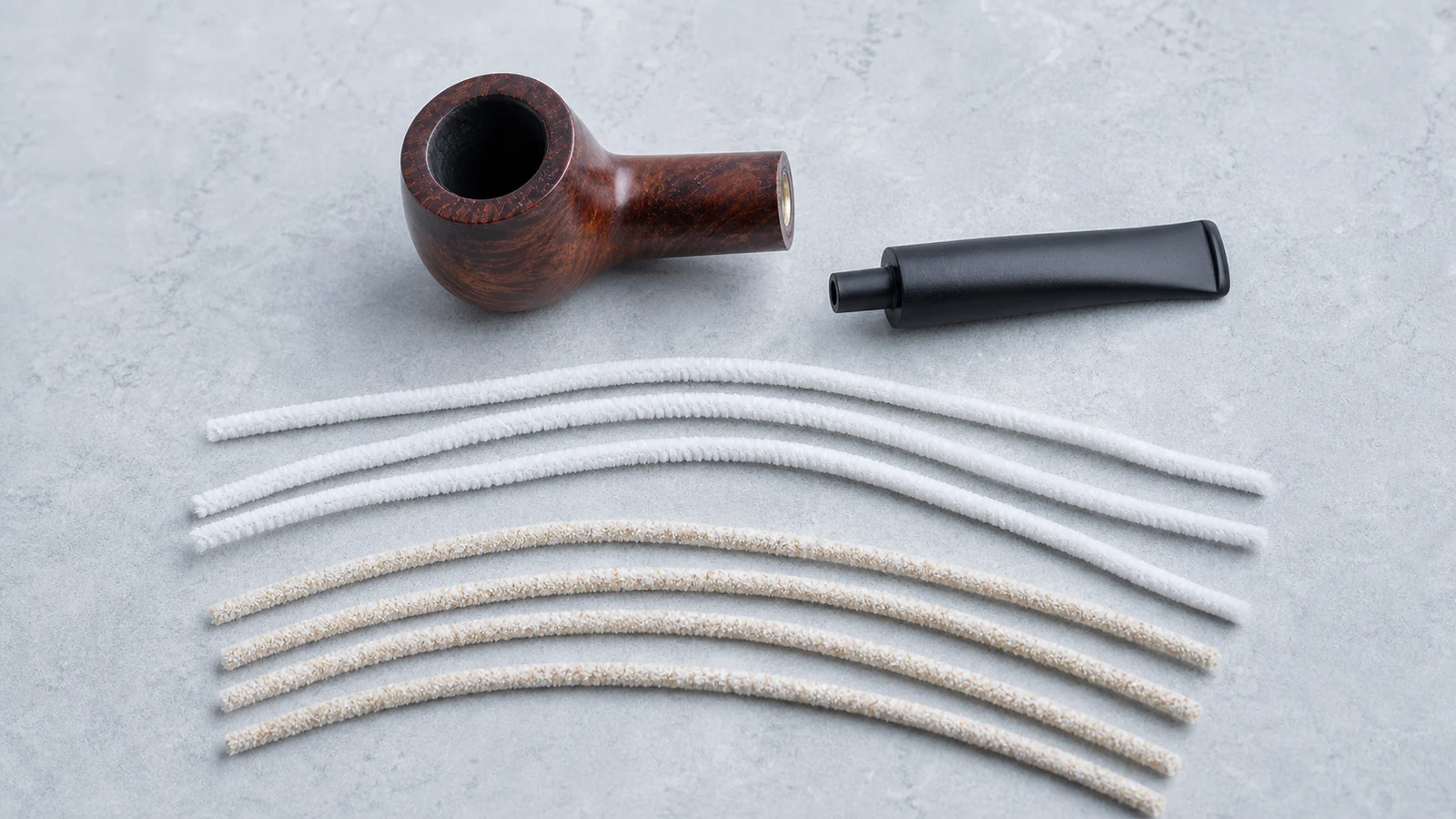
A tobacco pipe cleaning kit needs three layers, not the largest possible tool count. The minimum routine layer is a supply of clean purpose-made soft cleaners, a clean low-lint cloth, a protected work surface, good light, and the exact pipe's care notes. System-dependent items belong only to a documented filter, stem, airway, finish, or material. Optional assessment tools, such as a bristled cleaner or reamer, are added for a defined condition rather than treated as standard equipment.
This site sells pipes, not prepacked cleaning kits or cleaning accessories. The checklist helps organize items bought elsewhere without implying that a cleaner, brush, filter, polish, or reamer fits a current catalog pipe. Use the cleaning Hub for the care sequence and the pipe-cleaner guide for cleaner construction and metal-core limits.
The three-layer cleaning kit
| Layer | Item | Purpose | Evidence required before use |
|---|---|---|---|
| Minimum routine | Clean purpose-made soft cleaners | Accessible moisture and loose residue | Cleaner remains aligned and controllable; no exposed or kinked core |
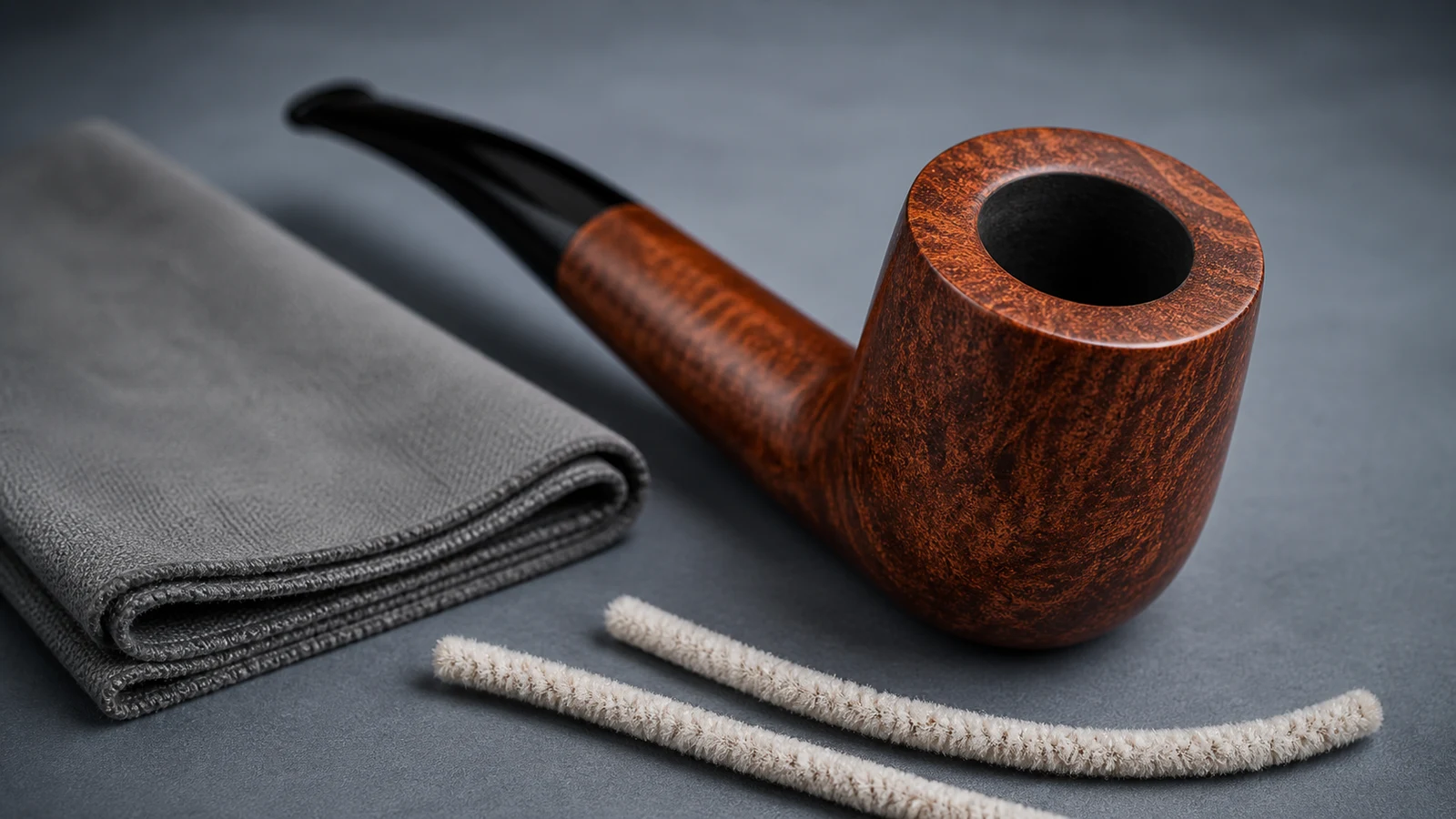
| Minimum routine | Clean low-lint cloth | Light contact with a stable exterior | Cloth is clean; finish shows no color transfer, tackiness, or flaking |
| Minimum routine | Tray, mat, or folded clean cloth | Prevents rolling and hard-surface contact | Surface is clean, broad enough, and free of grit |
| Minimum routine | Good neutral light | Makes condition and openings visible before action | Glare and shadow are not treated as proof of damage |
| Minimum routine | Pipe-specific care card | Keeps model, materials, system, and instructions together | Facts come from the exact listing, maker, or documented inspection |
| System-dependent | Tapered, thin, flexible, or extra-long cleaner | A route that the regular cleaner category does not address | Cleaner type and route are documented; easy withdrawal remains possible |
| System-dependent | Filter, adapter, condenser, or maker-specified brush | A named system or care task | Exact model, part, size, inclusion, and instructions agree |
| System-dependent | Material-specific liquid or polish | A maker-approved surface or care step | Exact material, product, method, and affected surface are documented |
| Optional assessment | Bristled cleaner | More contact against confirmed residue | Passage, material, cleaner construction, and need are known |
| Optional assessment | Reamer or other removal tool | Assessed internal buildup | Chamber condition, tool geometry, working range, and method are established |
The table is a composition guide, not a prepacked shopping list. A small kit with a documented purpose for every item is more complete than a large kit whose tools, liquids, or replacement parts have unknown fit.
Minimum routine layer: observation and low-contact care
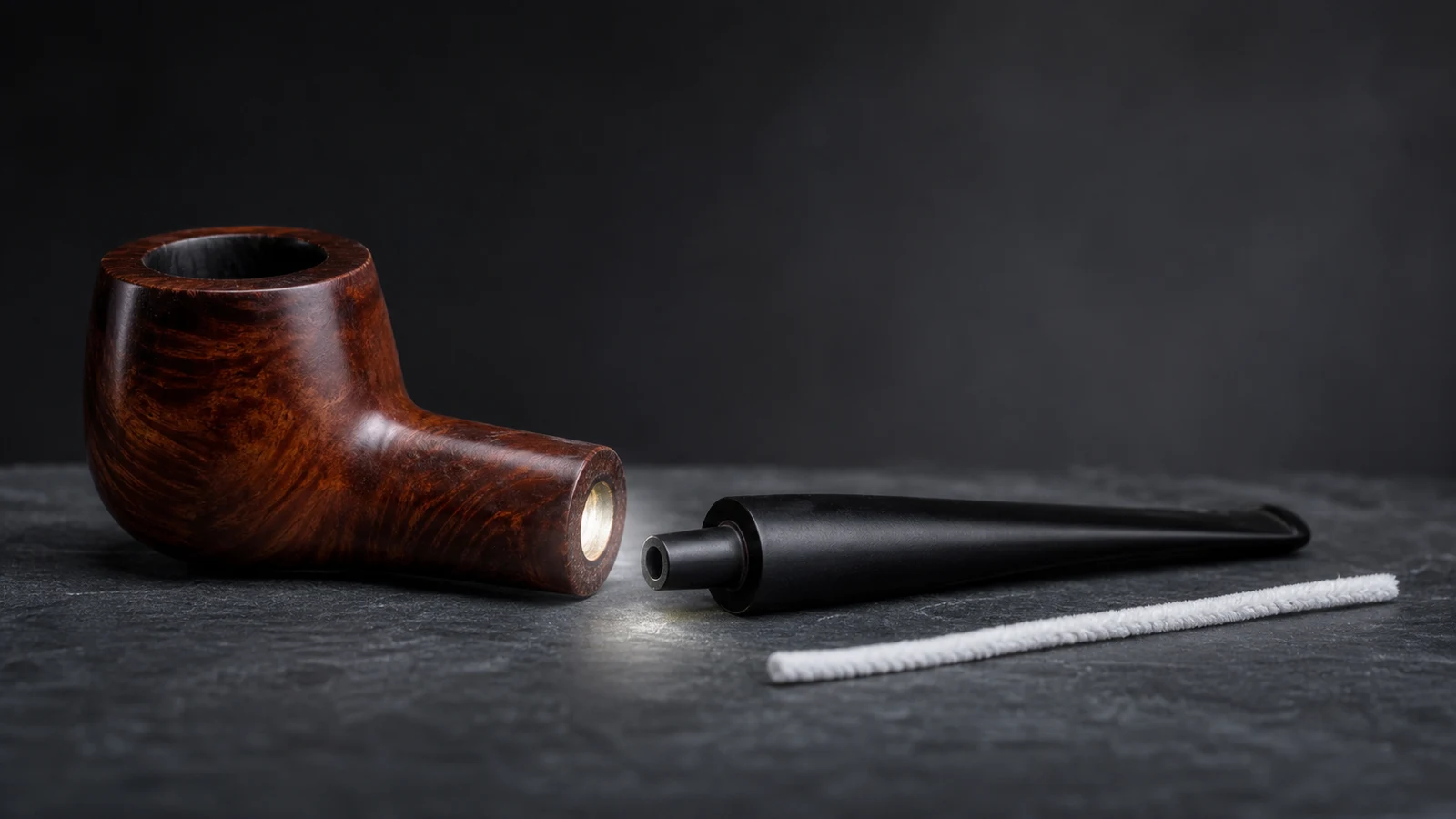
Keep several clean soft cleaners so a wet, marked, frayed, or bent one can be replaced instead of reused. “Regular” and “soft” are product categories, not standardized diameters. The cleaner must remain controllable at the documented opening; do not infer fit from an exterior stem photo or an airway number in a different listing.
A clean cloth, protected surface, and good light reduce avoidable handling problems. The cloth should not contain grit or residue. The tray or mat should keep the pipe and any maker-approved removable part away from an edge. Light should reveal the rim, bowl, shank, stem, joint, and markings without turning a reflection or shadow into a condition claim.
The care card is part of the minimum layer because it records the limits that the tools cannot reveal:
- maker and exact model, when known;
- stated bowl, stem, and finish materials;
- filter, adapter, or condenser arrangement;
- maker-described disassembly and care method;
- known repairs or condition concerns;
- cleaner types that were tried and what happened, without converting an observation into a compatibility guarantee;
- source and date for every instruction.
No hands-on kit or cleaner comparison was performed for this article. A note such as “the cleaner stopped at the joint” is an observation; it does not prove the route is blocked, identify the internal geometry, or establish that a different product will fit.
Cleaner fit: control the core as well as the fibers
Many disposable cleaners hold fibers around a flexible metal core. A cleaner can bow or kink because of its angle, unsupported length, fiber compression, route geometry, prior damage, or internal resistance. Buckling is therefore a stop signal, not a diagnosis of clogging or wrong size.
Before a cleaner enters the kit, reject it if the core is exposed, the end is sharp, the cleaner is permanently kinked, or fibers are loose or contaminated. During the care step, stop when the cleaner cannot advance and withdraw with light control. Do not repeatedly straighten a kinked core, strip fibers to make it thinner, or substitute bare wire.
The stem-and-airway guide explains the care boundary for a known route. If a correctly selected cleaner repeatedly stops, use the clogged-airway triage instead of escalating cleaner stiffness or force.
System-dependent layer: label each item to one pipe or system
A long cleaner may be relevant to a documented long route; a tapered product may offer a narrow leading section; a shank brush may be made for a stated diameter and task. Those descriptions do not transfer automatically between pipes. Store the product specification with the care card and label any model-specific part.
Filters, adapters, and condensers are not generic cleaning-kit components. Keep them identified by maker, model, system, and part reference. A shared nominal number does not prove interchangeability, and an airway label does not by itself prove filter capacity.
Liquids and polishes also stay out of the minimum layer. A recommendation must name the material and surface it applies to, along with the exact product and method. Finishes, stem materials, adhesives, repairs, filters, and inserts vary; an unlabeled bottle or generic solvent recipe has no place in a pipe-specific kit.
Optional assessment layer: more contact is not a routine upgrade
A bristled cleaner increases contact but does not identify the residue or make an unknown route safe. It should not be used simply because a soft cleaner stopped. Confirm the passage, material, cleaner construction, and maker or repair guidance first.
A tamper and reamer also have different jobs. The presence of a tamper in a commercial bundle does not make it a scraper. A reamer is a material-removal tool whose fit depends on chamber geometry and condition, not the exterior bowl shape. Hard or uneven internal buildup, a previous repair, or an uncertain chamber should move the task to the bowl-care guide or an experienced repairer.
Keep knives, screwdrivers, drill bits, needles, exposed wire, abrasive pads, unidentified liquid, pressure devices, pliers, and unlabeled replacement parts out of the kit. They do not become appropriate because they are stored beside purpose-made tools.
How the source evidence maps to the three layers
- The specialist Smokingpipes cleaning guide places ordinary cleaners, bristled cleaners, cloths, and deeper-care tools in different maintenance roles. It supports separating routine and condition-led items, not a universal kit or fit claim.
- Savinelli's manufacturer maintenance overview supports following a maker-specific care context and using purpose-made cleaners. It does not establish that its routine or accessories transfer to every pipe.
- Missouri Meerschaum's BJ Long Regular Pipe Cleaners listing describes one cotton cleaner product for seller-defined medium and small pipes. It illustrates why product construction and intended class must be recorded, not assumed from “regular.”
- The rebornpipes estate-pipe repair archive contains cases with varied condition and prior work. It supports separating assessment and repair from the minimum routine layer; it does not certify a specific tool for an unknown pipe.
Current evidence is public manufacturer, specialist, seller, and repair material rather than a first-hand test. It cannot name a “best” cleaning kit or confirm compatibility with current catalog products.
Build the next step around the care task
Use the minimum layer for observation and low-contact routine care. Add a system-dependent item only when the exact pipe or maker documentation calls for it. Treat bristled cleaners, reamers, and other removal tools as condition-dependent rather than signs of a complete kit.
Continue to the cleaning Hub to choose the correct care path, then use the bowl-care guide or stem-and-airway guide for the affected area. For a current store listing, the contact page can clarify what its source record states; it cannot turn an outside accessory into a verified match.
Related posts
Product notes, store updates, and purchase guidance for the storefront.