How to Troubleshoot a Clogged Tobacco Pipe Without Force
Troubleshoot a clogged tobacco pipe without force by checking cooling, cleaner fit, filters, joints, and clear conditions for stopping.
Written by
The Tobacco Pipe Editorial Team
The store editorial team reviews product facts, care boundaries, and buying guidance against the current catalog and source evidence.
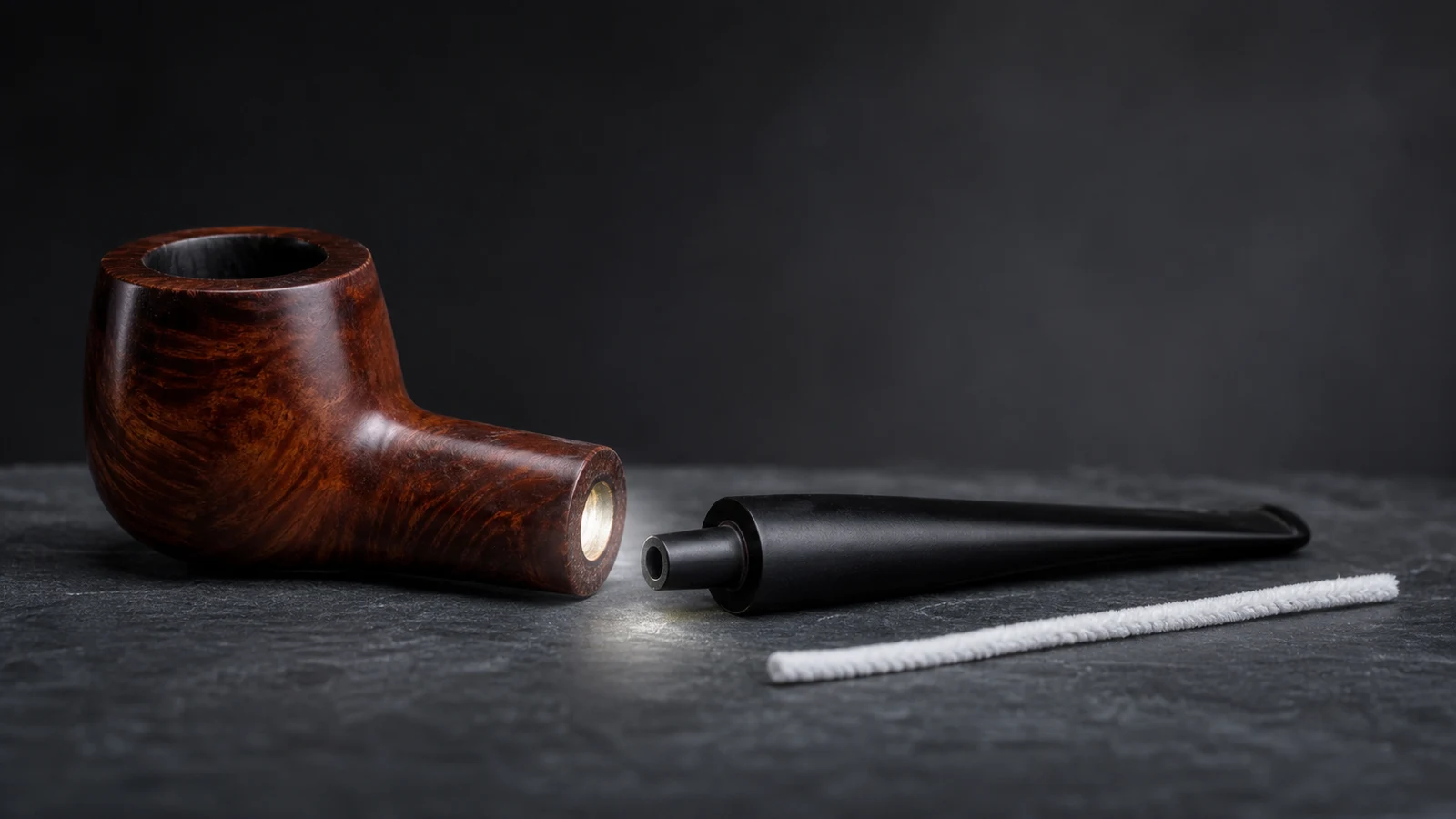
If a tobacco pipe seems clogged, stop, set it on a stable surface, and let it cool completely. Troubleshoot the branch before trying to clear it: confirm the cleaner fit, check whether a filter or insert is documented, note whether the joint changed, and record where a light pass stops. If the cleaner will not enter or stops at the same point, withdraw it. Do not force it, drill the airway, substitute steel wire, soak the pipe, or add a strong solvent.
A blockage can be loose residue, moisture, a filter or adapter, a tight bend, a misaligned joint, a damaged component, or simply a cleaner that does not fit. The correct response depends on the pipe's documented construction and condition. This article describes a low-intervention check, not a universal repair, restoration method, or guarantee against damage.
This page starts where routine care stops. Use the stem-and-airway guide for an airway that accepts a correctly fitting cleaner; use this triage only when that normal pass repeatedly stops or the restriction persists.
Troubleshooting decision tree
Follow the branches in order. End the check as soon as one branch produces a stop condition.
| Decision | If yes | If no or uncertain |
|---|---|---|
| 1. Is every part at room temperature? | Continue to the fit check | Leave the pipe supported and wait; do not handle the joint |
| 2. Is this cleaner already known to fit this accessible passage? | Inspect it for exposed wire, bends, debris, or damage | Use the pipe-cleaner fit guide; do not treat a failed oversize cleaner as proof of a clog |
| 3. Is a filter, adapter, condenser, or other insert documented? | Follow the exact maker instructions and confirm its arrangement | Do not pry out a part or infer the internal route from appearance |
| 4. Is loose material visible at an accessible opening? | Let only freely moving material fall away over a soft surface | Do not probe for hidden material |
| 5. Does a suitable soft cleaner advance with light control? | Make one short, aligned pass and withdraw it normally | Stop if the core bows or buckles, the cleaner jams, or leverage is needed |
| 6. Does the cleaner stop at the same point again? | Record the entry point and approximate travel, then end the attempt | Do not repeat passes merely to prove the airway is open |
| 7. Is the joint resistant, misaligned, loose, cracked, or previously repaired? | Leave the assembly alone and seek pipe-specific assessment | Keep the joint outside this troubleshooting attempt |
This tree separates a tool-fit problem, a documented filter or insert, loose accessible residue, a persistent internal stop, and a joint or condition problem. It does not diagnose a hidden obstruction from exterior appearance or airflow alone.
Start by confirming that the pipe is actually clogged
Reduced airflow and a physically blocked airway are not the same conclusion. A cleaner may stop because the passage curves, because a removable element is present, because the cleaner is too thick, or because the joint is not aligned as expected. A generic photograph cannot settle which explanation applies.
After complete cooling, look at the bowl, shank opening, stem opening, and any visible filter cavity without inserting a hard object. Note whether the issue appeared suddenly, whether the pipe was recently disassembled, and whether a filter, adapter, or condenser is documented. Compare the pipe with its maker instructions or current listing rather than with an unrelated model.
Do not treat a nominal filter label, similar shape, or visual resemblance as proof of internal construction. The product guide explains how to separate visible catalog details from specifications that still need confirmation.
Remove only material that is already loose
Support the cool pipe over a clean, soft surface. If loose particles are visible at an accessible opening, allow them to fall out without striking the bowl or scraping the passage. A gentle exterior tap with a fingertip may move free material, but stop if nothing moves easily.
Do not reach into the airway with a drill bit, needle, steel wire, knife, screwdriver, or improvised brush. A hard tool can catch at a bend, mark an internal surface, disturb an insert, or turn a small obstruction into a more complicated repair. Do not pour liquid through the pipe to flush an unknown blockage. Liquid may contact finishes, adhesives, repairs, or materials whose compatibility has not been established.
Hard chamber buildup is also outside this check. If material is attached to the bowl wall or appears thick and uneven, leave it in place. Assessment and possible reaming require the correct tool, fit, material knowledge, and control; they should not be improvised because the airway seems restricted.
Try a soft cleaner only when the fit is gentle
Choose a purpose-made, soft pipe cleaner whose fibers make only light, controlled contact with the accessible opening. Keep it aligned with the visible entry path and advance it in short movements under light fingertip guidance. The wire core should remain controllable; stop if it bows or buckles, the cleaner jams, or movement needs leverage.
Resistance is a result, not a request for more pressure. Withdraw the cleaner slowly if it catches. Check whether its tip is bent, frayed, exposing wire, or carrying loose residue. A fresh cleaner of an appropriate type may be tried only if the first one was clearly damaged or poorly sized; repeated stopping at the same point is a reason to end the attempt.
Do not assume that a cleaner must pass all the way through every design. Some pipe geometries, filters, adapters, condensers, and joints change the route or limit access. The fact that a cleaner does not emerge elsewhere is not enough to diagnose the pipe or justify enlarging the passage.
The specialist Smokingpipes cleaning guide describes ordinary airway maintenance. When that low-force method fails, the repair cases in the rebornpipes archive are useful evidence that alignment, deposits, tenon condition, and prior work can require different diagnoses—not reasons to escalate blindly. Cleaner construction and fit are covered separately in the pipe-cleaner guide.
Do not force the stem or filter assembly
Many online instructions move directly to removing the stem. For an unfamiliar pipe, first verify that the joint is intended to separate, that the assembly is fully cool, and that no crack, band movement, repair, or loose fitting is visible. If the documented joint does not move under the light handling its instructions describe, stop.
Do not twist harder, pull at an angle, use pliers, heat or chill the joint, or introduce lubricant or solvent. These actions add mechanical or material risks without identifying the blockage. A stuck or misaligned joint is a separate condition that may need hands-on service.
If a filter or insert is visible, do not pry it out unless its removal method is confirmed for the exact pipe. Similar-looking parts are not necessarily interchangeable. Record any printed size, maker name, adapter, or cavity detail, but treat those observations as evidence to verify rather than proof of fit.
Know when the cleaning attempt is over
Stop and seek maker-specific guidance, seller clarification, or an experienced repairer when any of these applies:
- the pipe has not cooled completely;
- a soft cleaner cannot enter without force;
- the cleaner catches or stops repeatedly at one location;
- the stem joint resists, creaks, or moves at an unexpected angle;
- a crack, split, loose band, shifted fitting, or prior repair is visible;
- an unknown filter, adapter, condenser, lining, or insert may be present;
- hard material appears attached inside the bowl or airway;
- the finish transfers color, turns tacky, clouds, swells, or flakes;
- residue, moisture, or an odor cannot be identified;
- the pipe's material, condition, or disassembly method is uncertain.
Take clear photographs before attempting anything else. Include the bowl, rim, shank, stem, joint, markings, and the point where an accessible cleaner stops. For questions about a current store listing, the contact page can clarify what the listing states. A listing answer cannot replace physical inspection when damage or a hidden obstruction is suspected.
For the complete low-intervention sequence before obstruction triage, return to the cleaning Hub. The maintenance section in Savinelli's maker guide is useful for routine context, but it is not evidence that one method clears every brand, filter system, or previously repaired pipe.
What product photos can and cannot confirm
Photos may show the external shape, visible openings, a removable part placed beside the pipe, printed markings, and obvious exterior condition. They may also help identify whether the received item differs visibly from its listing. Use those observations to ask a precise question.
Photos usually cannot confirm the complete airway path, internal diameter, depth of a blockage, hidden repair, chemical compatibility, or whether a part that looks removable should be removed. Ask the seller or maker for the exact model, stated materials, filter arrangement, dimensions where relevant, and care or disassembly instructions. Do not infer those facts from scale or appearance alone.
Frequently Asked Questions
What should I do first when a tobacco pipe seems clogged?
Stop, support the pipe securely, and wait until it is completely cool. Then inspect accessible openings and confirm the documented filter or joint design. Do not begin by forcing a tool or separating an unfamiliar assembly.
Can I push a wire through a clogged pipe?
No. Do not use steel wire, a drill bit, needle, or another hard improvised tool. If a soft correctly fitting cleaner will not pass with gentle movement, withdraw it and obtain pipe-specific guidance.
Should I use liquid or solvent to clear the blockage?
Do not flush or soak an unknown pipe based on general advice, and do not use a strong solvent. Finishes, adhesives, repairs, inserts, and stem materials vary. Any liquid treatment needs instructions for the exact construction and condition.
Which details should I ask the seller or maker to confirm?
Ask for the exact model, stated bowl and stem materials, intended disassembly method, filter or adapter arrangement, relevant dimensions, known repairs, and care instructions. If the pipe is used, also ask what condition is known rather than assuming the obstruction is routine residue.
When does a clogged pipe need professional help?
Seek experienced help when gentle access fails repeatedly, the joint resists, damage or an old repair is visible, an insert is unidentified, or the blockage cannot be observed. Those conditions call for diagnosis, not escalating force.
The conservative rule is simple: cool first, observe carefully, use only a soft cleaner that fits without force, and stop at resistance. Preserving the pipe and the evidence around the problem matters more than clearing the airway in one session.
Related posts
Product notes, store updates, and purchase guidance for the storefront.