Tobacco Pipe Cleaners: Types, Fit, and Common Mistakes
Compare soft and bristled tobacco pipe cleaners, fit, gentle-use limits, and common mistakes without assuming one cleaner suits every airway.
Written by
The Tobacco Pipe Editorial Team
The store editorial team reviews product facts, care boundaries, and buying guidance against the current catalog and source evidence.
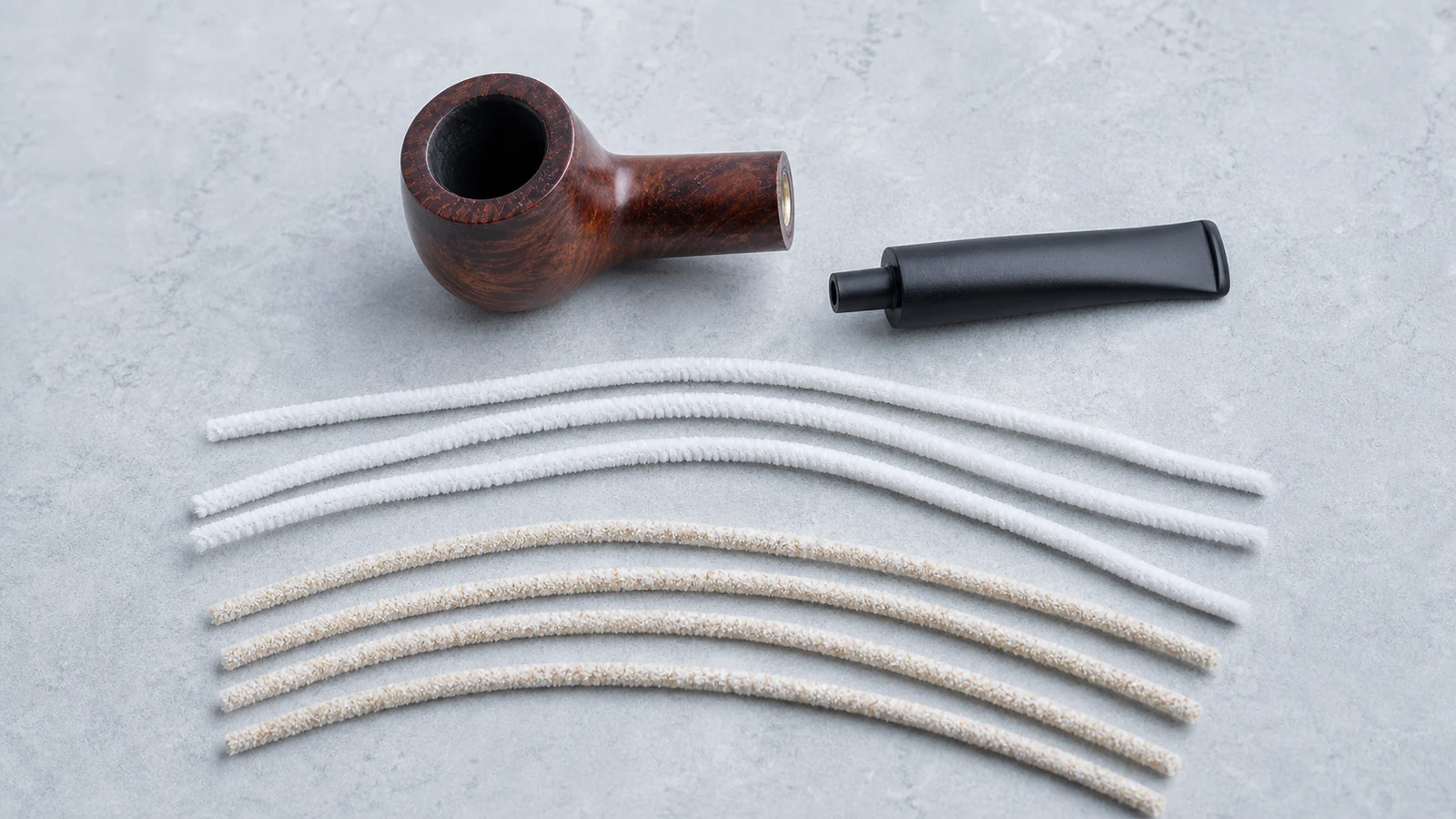
Choose a tobacco pipe cleaner by task and controlled contact, not by a “best,” “standard,” or “heavy duty” label. A soft cleaner is the lower-contact choice for routine accessible moisture and loose residue. A bristled cleaner creates more surface contact and belongs only in a known passage for a defined need. Tapered, extra-thin, and extra-long cleaners solve different access problems; none is automatically compatible with a pipe because its package name sounds appropriate.
Fit is a handling limit, not a diameter guess. Stop when the cleaner no longer advances or withdraws with light control. If its metal core bows outside the opening, kinks, catches, or begins to show through the fibers, remove and discard it. Buckling does not prove that the airway is blocked or that the cleaner is the wrong nominal size; it only shows that controlled feeding has been lost.
This site sells pipes, not cleaners. Use this guide to identify a cleaner type and the questions its seller or the pipe maker must answer. The stem-and-airway guide owns the care sequence, while repeated resistance belongs in the clogged-airway triage.
Match the cleaner type to the task
| Cleaner type | Main purpose | Fit and contact question | Do not infer from the label |
|---|---|---|---|
| Soft or absorbent | Routine contact with accessible moisture and loose residue | Does it remain aligned and controllable without the core bowing or fibers bunching? | That “regular” fits every airway or that all fibers are equally soft |
| Bristled | More surface contact against confirmed residue | Is the passage and material known, and does the maker's care guidance permit it? | That more contact is safer, faster, or suitable for routine use |
| Tapered | A narrow lead section followed by a wider fiber section | Can the intended section enter and return without the wider portion jamming? | That one cleaner provides two verified sizes |
| Extra-thin or flexible | Access where a regular product is too bulky | Does the core remain controlled through the documented route? | That a narrow product can safely probe an unknown bend or obstruction |
| Extra-long | Additional reach for a documented long route | Is the length useful without encouraging the cleaner to fold or loop? | That length establishes thickness, flexibility, or full-route access |
| Brush or shank brush | A maker-described reusable cleaning task | Are diameter, material, route, and cleaning instructions specified? | That a brush is interchangeable with a disposable cleaner |
These are functional categories, not industry-wide dimensions. Two products called “regular” can differ in fiber bulk, stiffness, wire-core behavior, and length. Product specifications and the exact pipe's care information must carry the fit claim.
What the reviewed sources actually support
The available sources support a maintenance vocabulary, but not a universal fit rule:
- Savinelli's maintenance overview is a pipe maker's care page and supports the use of purpose-made cleaners within its own maintenance context. It does not publish a universal cleaner diameter or approve a cleaner for every brand and model.
- The specialist Smokingpipes cleaning guide places ordinary and bristled cleaners in different maintenance roles. It supports distinguishing contact level and task, not treating a bristled product as a default or a product label as proof of fit.
- Missouri Meerschaum's BJ Long Regular Pipe Cleaners listing describes that product as 100% cotton and positions it for medium and small pipes. Those are seller claims for one product, not standardized meanings for “cotton,” “regular,” “medium,” or “small.”
- The rebornpipes repair archive documents varied stem, airway, obstruction, and prior-repair conditions. It supports handing an uncertain case to diagnosis or repair; it does not set a measurable force threshold or prove why a particular cleaner stopped.
No hands-on cleaner comparison was performed for this article. The sources do not establish a winning brand, a universal replacement schedule, or compatibility with any pipe in the current catalog.
Fit means controlled movement, not full travel
A cleaner can stop for several reasons: a bend, filter, adapter, condenser, joint geometry, residue, damage, poor alignment, or the cleaner's own fiber bulk. The stop alone does not identify which one applies. Likewise, a cleaner passing through one pipe does not prove that it suits another pipe with a similar exterior shape.
Before contact, check four things:
- The pipe route: confirm any maker-described filter, adapter, condenser, removable stem, or known bend.
- The cleaner condition: reject an exposed core, sharp end, permanent kink, loose fibers, heavy shedding, or contamination.
- The cleaner specification: record type, length, fiber description, and any stated thickness or intended pipe class.
- The care boundary: know whether the maker describes cleaning the pipe assembled or separated and which opening is intended to be accessible.
Begin only when the pipe is cool and the documented route is understood. A suitable cleaner should remain aligned at the opening and move with light hand control. There is no universal insertion-force number in the reviewed sources. Do not use pliers, twisting leverage, or repeated jabs to make a cleaner pass.
The aim is not to make every cleaner emerge from the opposite end. Some assemblies do not permit a full pass in their normal configuration. Treat easy withdrawal as part of fit: a cleaner that enters but cannot return smoothly is not a successful compatibility test.
Metal-core bending is a stop signal, not a diagnosis
Many disposable pipe cleaners hold fibers around a flexible metal core. That core may bend because of hand angle, an external unsupported length, a route change, fiber compression, prior damage, or resistance inside the pipe. You cannot determine the internal cause from the bend alone.
If the unsupported section begins to bow, stop advancing and withdraw while control remains. Do not straighten a sharply kinked cleaner and send it back through the pipe. Repeated bending can disturb the fiber cover or expose the core, changing the contact surface that first entered the airway.
The core should never be used as an improvised probe. Do not strip off fibers, substitute bare wire, or use a needle, paper clip, or drill bit. A rigid tool can bypass the visible warning that a flexible cleaner is no longer following the route under control.
Contact changes with cleaner construction
Soft and bristled are relative product categories, not measured abrasion ratings. A soft cleaner can still catch at an edge or shed fibers. A bristled cleaner can concentrate contact at its stiff fibers and core, particularly in a narrow route or against an unidentified insert.
Use a bristled cleaner only when the residue, passage, material, and maker guidance are sufficiently known. It should not be used to overcome a stop met by a soft cleaner. Extra-thin cleaners also require restraint: easier entry does not give permission to probe an unknown cavity, repair, or obstruction.
Liquid changes contact and material risk. Do not soak a cleaner or introduce alcohol, polish, or strong solvent based on a generic recipe. Stem materials, finishes, adhesives, filters, inserts, and prior repairs vary. Follow exact maker guidance for any liquid treatment.
Replace the cleaner when control changes
Discard a cleaner when it is wet, heavily marked, permanently bent, frayed, shedding, contaminated, or showing its metal core. Replace it rather than folding it, reversing a damaged end, or repeatedly pushing the same residue through the route. Remove cleaners after the care step; they are not storage inserts.
End the task when resistance repeats at one location, a joint resists, an unidentified component moves, or damage or prior repair becomes visible. Note where the cleaner stopped and which type was used. A maker, seller, or experienced repairer can act on that description more reliably than on “the cleaner would not go through.”
The cleaning-kit checklist places cleaners in a minimum, system-dependent, and optional toolkit. Choose the type for a defined task, keep the core covered and controlled, and let a catch, kink, or loss of easy withdrawal end the attempt rather than explain it.
Related posts
Product notes, store updates, and purchase guidance for the storefront.