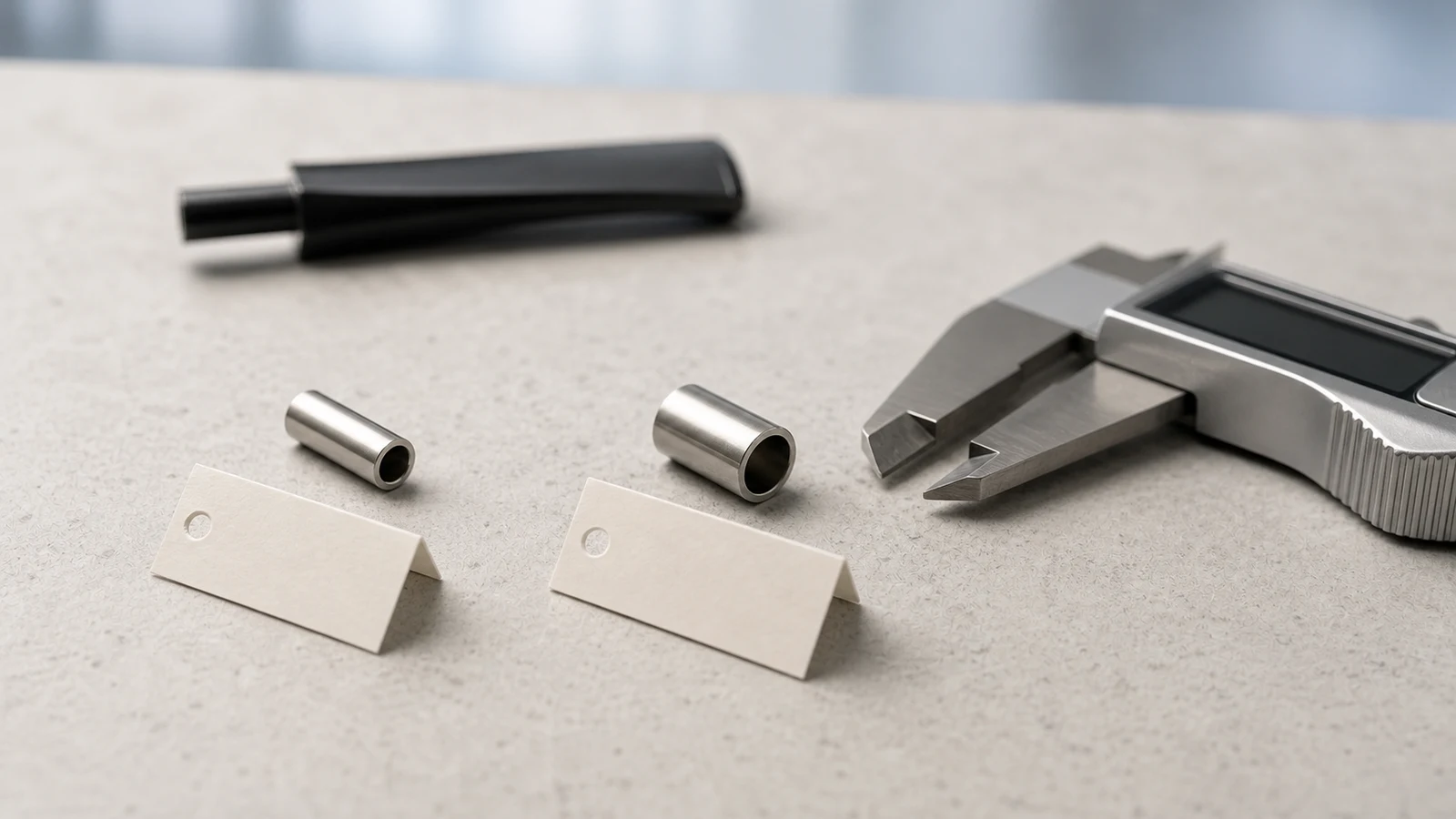
What Does “Cooling Chamber” Mean on a Tobacco Pipe Listing?
Treat cooling chamber as a listing claim that needs structural evidence, dimensions, and seller clarification rather than a performance guarantee.
Written by
The Tobacco Pipe Editorial Team
The store editorial team reviews product facts, care boundaries, and buying guidance against the current catalog and source evidence.

The sources reviewed for this guide did not establish one industry-wide definition for “cooling chamber.” On a tobacco pipe listing, treat it as the seller's label for a stated feature—not proof of a standardized mechanism or a guaranteed result. Unless the exact listing supplies a diagram, dimensions, construction details, and clear terminology, do not choose among possible internal structures from the phrase alone.
The most conservative buying response is to ask what physical part the label identifies, where it is located, whether it is removable, and which claims the seller is actually making. Do not turn the words into an assurance about temperature, moisture, airflow, comfort, safety, or smoking performance. The site's product guide offers a broader method for keeping listing text, visible evidence, and unknown specifications separate.
There is no useful assumption hidden in the phrase
“Cooling chamber” sounds descriptive, but the two words do not provide a measurement or a shared technical definition. Two sellers can use the same label for different structures. One listing may apply it to a visible metal component; another may refer to an internal space that cannot be seen in the assembled product. A third may use the term without identifying a separate part at all.
That ambiguity matters because the label alone cannot answer basic questions:
- Is the feature a hollow space, insert, connector, or decorative housing?
- Is it part of the shank, stem, tenon area, or another location?
- Is it fixed, detachable, adjustable, or replaceable?
- What material does the seller state for the component?
- Does the diagram represent the exact item or a generic design?
- Are dimensions supplied for the structure and its openings?
- Does it change compatibility with cleaners, filters, or replacement parts?
If the product page does not answer those questions, describe the feature only as “listed as a cooling chamber” and keep its construction unresolved.
What the current catalog records actually establish
The July 2026 local catalog fixture contains 150 product records. Fifteen have
Cooling Chamber in the source-derived product name and the structured
Features field. Two different records use System in those fields. No record
combines the two labels, so the catalog does not support treating them as
synonyms.
Those counts prove only that the source listings supplied labels which the
catalog preserved. The fixture does not include a cooling-chamber location,
cross-section, internal geometry, component material, capacity, service
instructions, or measured temperature or moisture result. It also does not
define what System means on either system-labeled item. A few descriptions
repeat that the source listing “notes a cooling chamber,” but repetition of the
same source claim is not independent technical confirmation.
Accordingly, a catalog example may be described as “source-labeled Cooling Chamber” or “source-labeled System.” It must not be described as having a Peterson-style reservoir, a standardized internal structure, or a proven performance effect. Use the pipe-parts guide to identify which location an exact seller claims before assigning any more specific terminology.
Peterson's first-party System range documents Peterson's own named design. It is useful here only as a boundary: maker-specific documentation is required before a named construction can be described. It is not evidence for the 15 cooling-chamber records or the two system-labeled records in this catalog.
Separate the label, the visible structure, and the claimed benefit
Use three evidence columns when reading a listing:
| Evidence layer | A careful record might say | Do not conclude |
|---|---|---|
| Seller label | “The listing calls this a cooling chamber” | The phrase has one industry-wide design |
| Visible structure | “The photo shows a widened connector-like section” | The hidden interior matches the exterior shape |
| Diagram or dimensions | “The seller supplies this cavity diagram and measurement” | The diagram proves a particular result |
| Benefit wording | “The seller claims the feature is intended to cool” | The claimed benefit is independently guaranteed |
| Missing evidence | “Internal construction is not shown” | A familiar-looking design fills the gap |
This separation avoids two opposite errors. It does not dismiss a seller's feature label, but it also does not expand that label beyond the evidence provided for the exact item.
What photos can and cannot show
Product photographs may reveal an external housing, a widened shank section, vent-like openings, threads, a removable-looking joint, or an extra component shown beside the pipe. Multiple angles can help determine whether the visible shape is part of the stem, shank, or an accessory. An exploded photograph may show how several visible pieces align.
Even a strong gallery has limits. Exterior photos do not reliably establish the shape of an enclosed cavity, the route or diameter of an airway, whether a part is hollow, the material beneath a finish, the sealing method, or the way a feature behaves in use. A dark opening is not a measurement, and a seam is not proof that the piece is intended to be removed by the buyer.
Do not disassemble a product based only on the appearance of a joint. Ask for the seller's instructions and a parts diagram when removal or maintenance is relevant. A component can be assembled at the factory without being a user-serviceable part.
Questions that turn a vague label into useful facts
Ask the seller a short, item-specific set of questions rather than asking whether the feature “works.” Useful questions include:
- What exact physical structure does “cooling chamber” identify on this item?
- Where is it located in relation to the bowl, shank, airway, and stem?
- Is there a cross-section, exploded view, or written construction diagram?
- What dimensions and materials are stated for the feature?
- Is it fixed or removable, and are user instructions supplied?
- Does the feature affect the stated filter system or cleaning-tool fit?
- Are replacement parts required or available?
- Do the photos show the exact item shipped or a representative example?
The answer may reveal that “cooling chamber” is simply seller terminology for a visible connector. It may instead identify a documented internal structure. Either outcome is more useful than relying on the phrase alone.
Why the label is not a performance guarantee
A feature name can describe intent without proving outcome. “Cooling” in the label does not establish a measured temperature change, and “chamber” does not establish capacity or internal geometry. Results could depend on construction, dimensions, materials, assembly, condition, and variables the product page does not document.
Accordingly, avoid claims that the feature makes a pipe cooler, drier, safer, more comfortable, easier to maintain, or superior to another design. Do not infer a health or safety advantage. If a seller provides test conditions and measured results, record them as the seller's claim with the stated limits; do not convert them into a universal promise.
This boundary also prevents a feature label from becoming a quality grade. A pipe without that label is not automatically inferior, and two pipes carrying it may not share the same construction.
Check compatibility as a separate decision
A visible section near the stem can affect the questions a buyer needs to ask, but appearance does not answer those questions. Filter compatibility requires an explicit system and size statement for the exact pipe. Cleaner fit depends on the documented airway and product instructions. Replacement components need part numbers, dimensions, or a confirmed model relationship.
The filter compatibility guide treats size and system evidence separately. A cooling-chamber label cannot supply a missing filter size, adapter specification, or cleaner path.
Do not assume that a “cooling chamber” accepts pellets, filters, adapters, inserts, or other accessories. Do not assume a removable-looking piece is optional. If the listing shows a loose component, confirm whether it is included, preinstalled, a photographic prop, or sold separately.
The shop can be used to compare current listing language and supplied photos. It should not be used to transfer compatibility from one item to another. Each individual product record controls its own specifications.
A repairer's Peterson System maintenance
discussion
is likewise system-specific. It may inform questions about a documented
Peterson design, but it cannot explain the construction, care method, or
performance of any catalog item merely labeled Cooling Chamber or System.
Pre-order cooling-chamber checklist
- Copy the exact seller wording without adding a technical definition.
- Identify the physical location the label is said to describe.
- Compare the full image set, including any exploded or cross-section view.
- Confirm whether the images show the exact item.
- Request dimensions and stated materials when they affect the decision.
- Confirm whether any part is user-removable and obtain instructions.
- Verify filter, cleaner, adapter, and replacement-part compatibility.
- Confirm every loose component in the written package-contents list.
- Keep intended benefits separate from measured, item-specific evidence.
- Recheck condition, price, stock, shipping, and returns before payment.
If several boxes remain empty, the sensible conclusion is not that the feature is ineffective. It is that the listing does not yet support a precise comparison.
Frequently Asked Questions
What does a cooling chamber mean on a tobacco pipe?
It means the seller applies that label to a feature or structure associated with the pipe. The phrase does not provide one standard construction. Ask the seller to identify the physical part, its location, dimensions, material, and intended function for the exact item.
Can photos confirm that a cooling chamber is present?
Photos may show an external housing, openings, joints, or loose components. They cannot reliably prove the geometry or function of a hidden internal space. A diagram and clear written specification are more useful than exterior shape alone.
Does a cooling chamber guarantee a cooler pipe?
No. The label is not a performance guarantee. Do not infer a measured cooling effect, moisture change, comfort improvement, safety benefit, or overall quality advantage without item-specific evidence and stated test conditions.
Which cooling-chamber details need seller confirmation before ordering?
Ask for the feature's location, construction, dimensions, stated materials, fixed or removable status, instructions, filter or accessory compatibility, replacement-part information, exact package contents, and whether the media represents the exact item shipped.
How can I audit current cooling-chamber listings against their product pages?
Review the current catalog, open each relevant product page, and use
the product guide to list confirmed fields and unknowns. The
current fixture contains 15 Cooling Chamber labels and two separate System
labels, but it does not define either construction. A similar title or exterior
profile does not prove that two listings use the words in the same way.
The value of the phrase lies in the questions it triggers, not in an assumed outcome. Identify the real structure, verify the seller's evidence, confirm compatibility and included parts independently, and leave any unmeasured benefit unpromised.
Related posts
Product notes, store updates, and purchase guidance for the storefront.