Tobacco Pipe Parts Explained: Bowl, Shank, Stem, Tenon, and Airway
Learn the names of visible tobacco pipe parts, what photos can confirm, and which hidden specifications still require seller verification.
Written by
The Tobacco Pipe Editorial Team
The store editorial team reviews product facts, care boundaries, and buying guidance against the current catalog and source evidence.
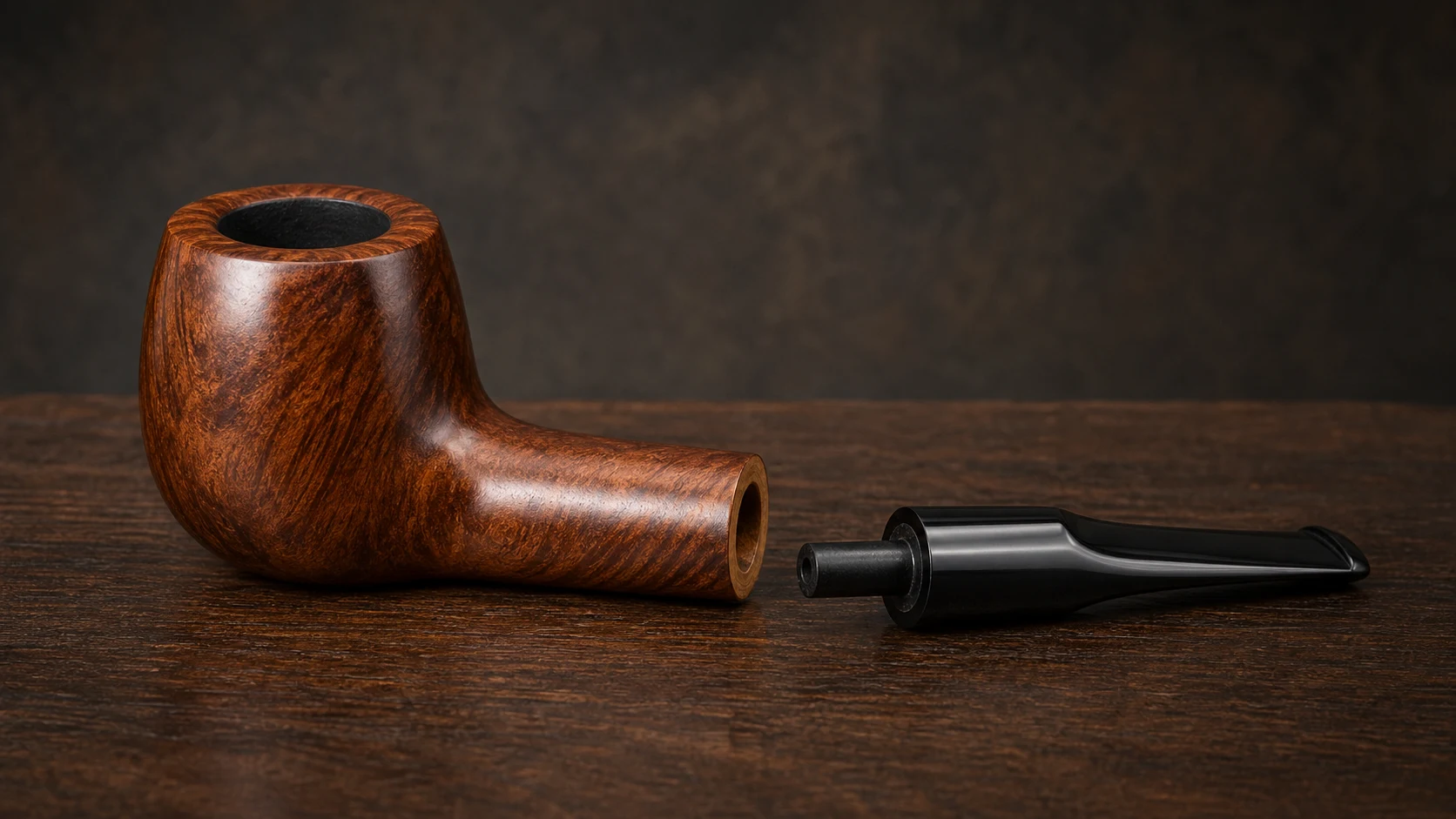
The main parts of a tobacco pipe are the bowl, shank, stem, tenon, mortise, and airway. Use one simple boundary: photos can describe the outside of the bowl, shank, and stem, while the joint and airway need product-specific text, measurements, or inspection. A tenon is normally hidden while the pipe is assembled, and the mortise is the opening that receives it.
Knowing these names makes it easier to read a product listing, compare shapes, and ask precise questions. It does not, however, reveal exact dimensions, condition, origin, filter compatibility, or included accessories. Those facts should come from the current product page or the seller, not from the pipe's silhouette alone.
A quick map of tobacco pipe anatomy
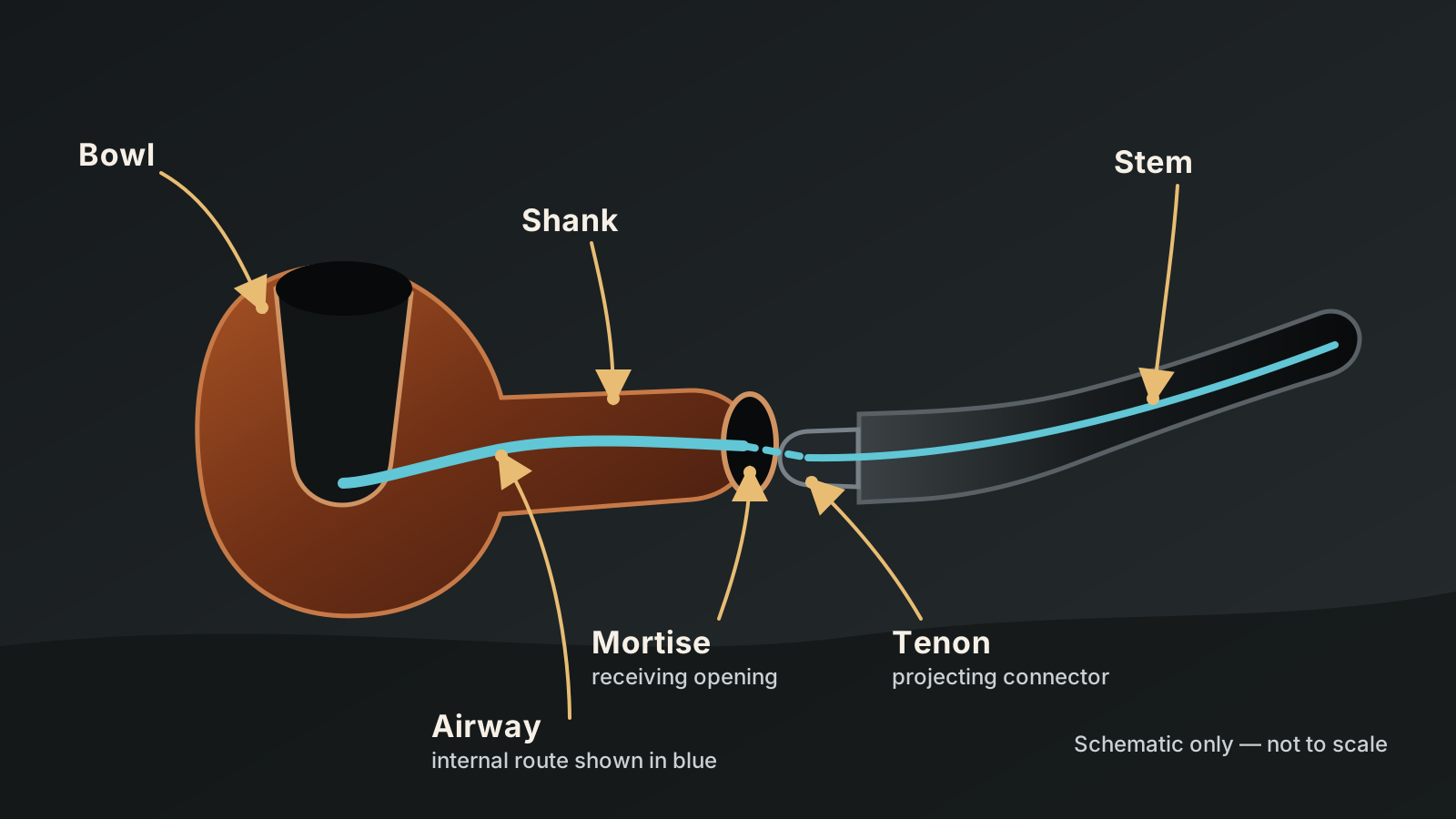
The stem is separated so the tenon and mortise can be seen. The blue airway is a schematic route, not a measurement or a technical drawing of a catalog product.
| Part | Where it is | What a photo may show | What still needs confirmation |
|---|---|---|---|
| Bowl | The rounded or shaped body at the front | Exterior shape, finish, rim, and visible opening | Exact chamber measurements, complete internal condition, and material unless stated |
| Shank | The section extending from the bowl | Length, outline, bend, and visible surface | Internal drilling, exact measurements, and construction details |
| Stem | The detachable or fixed-looking section leading to the mouthpiece | Straight or bent profile, color, and broad style | Material, internal condition, fit, and filter support unless stated |
| Tenon | The connecting end of a removable stem | Sometimes visible in a disassembled photo | Diameter, fit, material, and compatibility with another pipe |
| Mortise | The receiving opening in the shank | Sometimes visible when the stem is removed | Diameter, depth, condition, and fit with a specific tenon |
| Airway | The internal passage through the pipe | Only a small opening may be visible | Full route, internal diameter, alignment, and condition |
This map is intentionally conservative. A photo is useful visual evidence, but it is not a technical drawing and should not be treated as one.
For a terminology cross-check, PipeOnline's illustrated parts overview also separates the bowl, shank, mouthpiece, tenon, and mortise. This guide uses only those neutral component definitions; any use or performance statements on another site need their own evidence.
Which source supports which statement?
This article separates terminology, catalog facts, and editorial limits instead of asking one source to support all three.
| Statement used here | Evidence used | What the evidence does not establish |
|---|---|---|
| Bowl, shank, mouthpiece, tenon, and mortise are distinct component terms | PipeOnline's illustrated parts overview | Exact dimensions or construction of a product in this catalog |
| Mortise and tenon describe the receiving and projecting sides of a joint | PipeOnline's parts overview and Smokingpipes' pipe-terms glossary | Replacement-part fit or the condition of an assembled joint |
| Briar, stem material, dimensions, condition, and feature labels belong to an individual record | The exact product page and its source-reported description | Independent testing, hands-on inspection, or a performance result |
| A photograph shows only the supplied angle | The visible image itself | Hidden airway alignment, internal condition, or compatibility |
Pipedia's referenced materials and construction overview provides broader construction context. It is not being used to transfer a maker, material, or construction claim to an individual product.
A source-reported catalog example
The current Prince Apple Slightly Bent page shows how one listing can contain several kinds of facts. Its source record describes Spanish-imported briar burl, a Cumberland stem, flame and birdseye grain, and new-and-unused condition. It also reports a 151 mm overall length, 54.8 g weight, 20 mm chamber diameter, 32 mm chamber depth, and a 3 mm airway.
Those are source-reported product facts, not measurements made by this editorial team. The 3 mm airway entry is also not proof of filter compatibility. The photographs can support the visible Apple-family bowl, slight bend, finish, and exterior stem line; they cannot verify tenon size, mortise fit, internal alignment, or replacement-part compatibility.
The bowl: the most recognizable part
The bowl is the front body of the pipe. Shape names such as Billiard, Apple, Dublin, Bulldog, Egg, or Freehand generally describe the bowl and its relationship to the shank. Those labels help organize a catalog, but individual examples can differ in proportions and detail.
From a clear photograph, you may be able to compare:
- the overall bowl silhouette;
- whether the sides look rounded, tapered, straight, or sculptural;
- the visible rim and chamber opening;
- smooth, rusticated, sandblasted, carved, or other source-labeled finishes;
- visible grain or color variation.
Those observations should remain visual. A pronounced grain pattern does not prove a particular origin, grade, or performance result. Likewise, a clean rim in one angle does not establish the complete condition of the chamber. If condition matters, look for explicit product language such as new, used, restored, estate, or unknown.
The shank: the bridge between bowl and stem
The shank extends from the bowl toward the stem. Together, the shank and stem create the line that shoppers often describe as straight, slightly bent, bent, or full bent.
Shanks can appear round, oval, faceted, diamond-like, or irregular in photos. Some products may also use feature labels such as bamboo shank or army mount. Treat those terms as established only when the individual page states them. An editorial image or a resemblance to another pipe is not enough.
The outside of the shank is visible; its internal route is not. Photos cannot fully establish drilling, airway alignment, repair history, or the exact fit at the joint. If the product record does not address those details, they remain unknown.
The stem and mouthpiece
The stem continues the pipe's profile from the shank to the mouthpiece. In catalog browsing, it is reasonable to compare the visible stem line: straight, gently rising, sharply curved, long, compact, saddle-style, or another source-labeled form.
It is not reasonable to infer every specification from that line. Color does not prove material. A saddle-like outline does not prove that the seller uses the same terminology. A close-up of the mouthpiece may show its exterior, but it does not reveal the full internal condition.
When stem details affect a buying decision, check the listing for:
- the stated stem material, if supplied;
- whether the stem is removable;
- exact dimensions, if they matter;
- stated filter compatibility or a stated non-filter design;
- condition notes and close-up photographs.
Never assume that a stem from one pipe will fit another merely because the two look similar. The dedicated tobacco pipe stem guide shows how to separate visible stem form from fit, material, and filter claims.
The tenon: a small part with a specific job
On many removable-stem pipes, the tenon is the narrower projection that enters the mortise, the receiving opening in the shank. These two terms describe the connection: tenon for the projecting part and mortise for the receiving part.
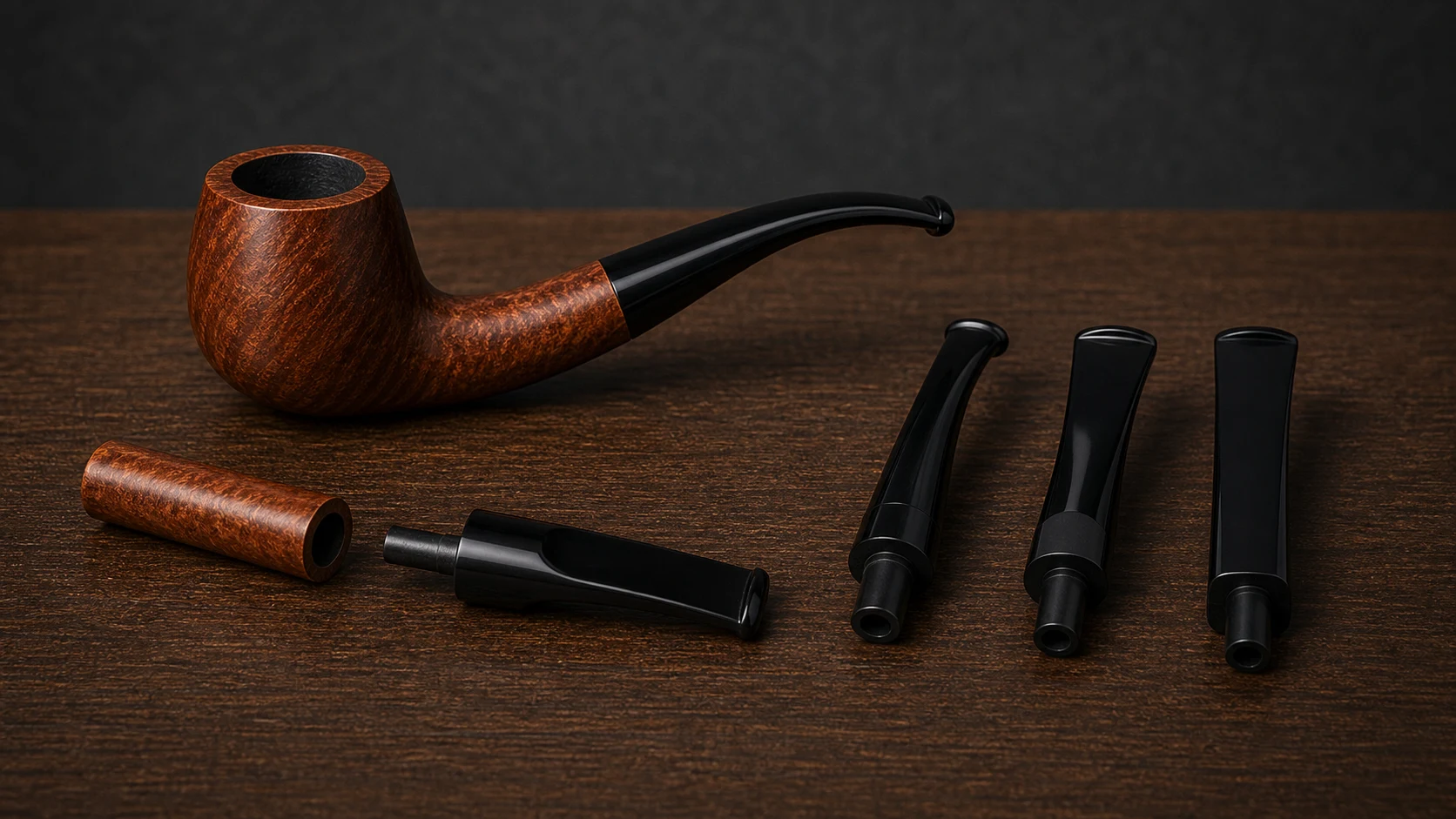
An assembled product photo normally hides both surfaces. Even a disassembled photo cannot prove exact fit, measurements, or compatibility with replacement parts. That is why searches for “tobacco pipe parts for sale” or “tobacco pipe parts kits” require more than a visual match. A buyer needs stated measurements and product-specific information before treating any component as compatible.
The airway: important terminology, hidden evidence
The airway is the internal passage running through the pipe. It may be possible to see an opening at the chamber or mouthpiece, but ordinary product photos do not show the complete route.
This distinction matters because product copy sometimes mixes visible facts with implied engineering. A straight-looking stem does not prove a particular internal diameter or alignment. A feature label such as “cooling chamber” may be repeated when it is present in the source record, but the name alone should not be converted into a guaranteed performance benefit.
If internal specifications are essential, ask the seller for the stated measurements or documentation. If no answer is available, label the detail unknown rather than filling the gap with an assumption.
Shape labels are not part names
It is useful to separate three layers of catalog terminology:
- Part names identify components: bowl, shank, stem, tenon, mortise, and airway.
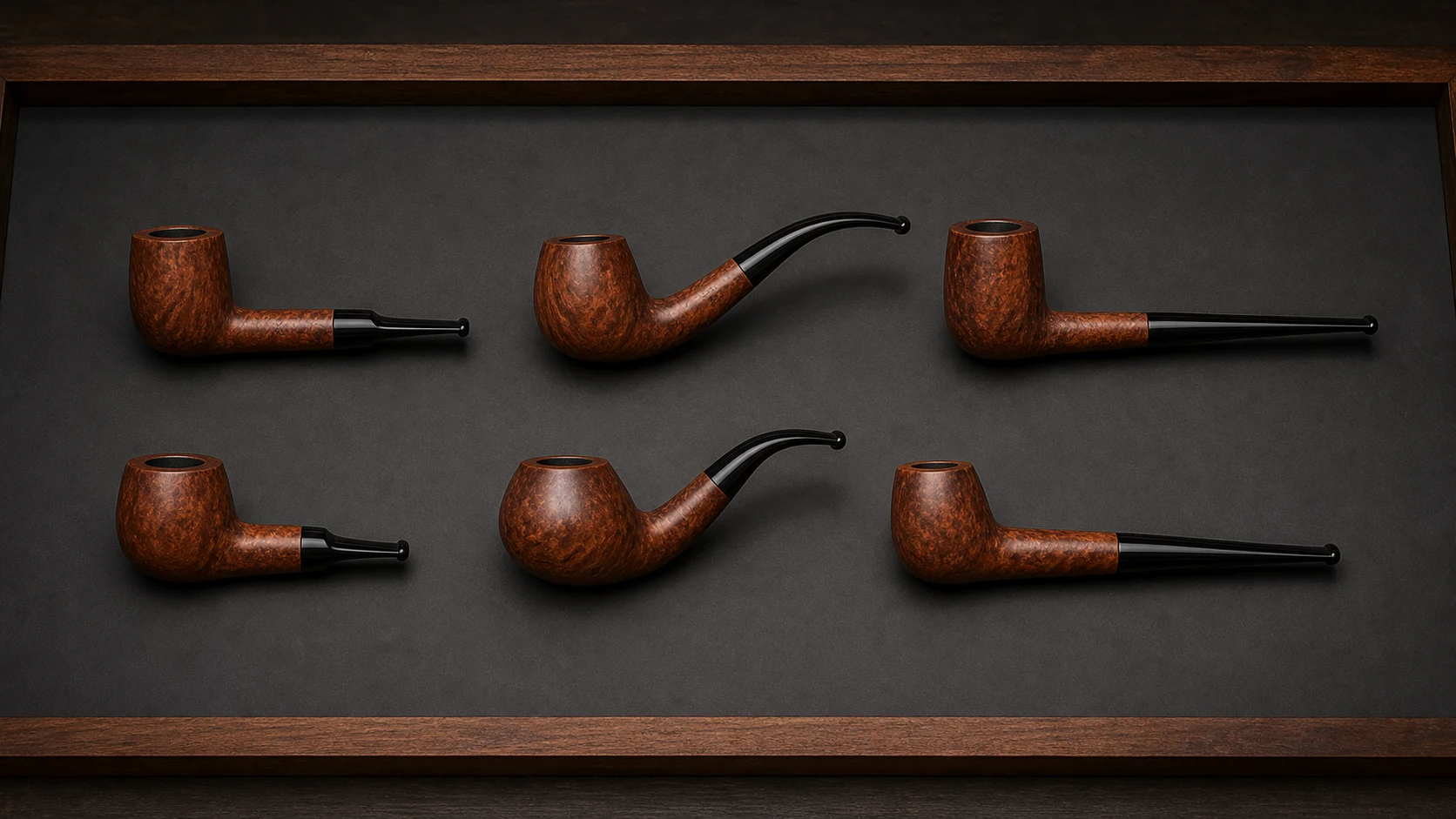
- Shape labels organize silhouettes: Apple, Billiard, Dublin, Bulldog, Churchwarden, Freehand, and others.
- Feature labels describe a visible or source-stated characteristic: rusticated, saddle stem, bamboo shank, army mount, sitter, 3mm, or 9mm.
The layers can overlap in a title, but they answer different questions. The source-reported Prince Apple example above combines a named bowl family and bend profile. Its title alone does not establish dimensions, filter size, condition, or package contents; those facts require the rest of the product record. For the broader classification system, continue to the tobacco pipe types guide.
The site's product guide uses this same evidence-first approach: begin with shape and visible details, then check specifications on the individual product page.
What product photos can and cannot confirm
Use this compact check before relying on a product page:
- Visible and comparable: silhouette, broad bend, relative proportions, supplied finish views, visible rim, and exterior stem line.
- Potentially stated but not safely inferred: material, maker, origin, condition, exact dimensions, and handmade status.
- Usually hidden or incomplete in photos: airway, joint fit, cleaning history, internal condition, and repair history.
- Commercial facts to recheck: current price, currency, stock, shipping, returns, and included items.
- Compatibility facts to check: filter size, replacement stem fit, stand fit, pouch fit, and tool sizing.
You can apply the checklist while browsing the current pipe catalog, then use the photo-inspection guide to audit which angles are present. The goal is not to diagnose every unseen detail from an image. It is to know which observations are solid and which questions remain open.
Are accessories tobacco pipe parts?
Usually, “parts” means components of the pipe itself, while “accessories” means separate items such as stands, pouches, cleaners, tampers, or reamers. Retail categories are not always consistent, so read the exact contents of the offer. A photograph showing several objects does not prove that all of them are included.
The same rule applies to a “starter kit.” The name is not an inventory list. Check each included item and any relevant dimensions before ordering.
Frequently asked questions
What are the parts of a tobacco pipe called?
The central terms are bowl, shank, stem, tenon, mortise, mouthpiece, and airway. The bowl, shank, and stem define most of the visible profile. The tenon and mortise form the connection on a removable-stem design, and the airway is internal.
What is the difference between a tenon and a mortise?
The tenon is the projecting connector on a removable stem. The mortise is the receiving opening in the shank. They form a joint, but their names do not prove that two separately sourced parts will fit.
Can the full airway be seen in a product photo?
Usually not. A disassembled view may show openings at the chamber, mortise, tenon, or mouthpiece, but it does not reveal the complete route, diameter, alignment, or internal condition.
Can I identify a replacement part from a photo alone?
No. A photograph can help identify the general type of part, but compatibility requires product-specific measurements and fit information. Do not treat a visual resemblance as proof that a replacement stem, tenon, or accessory will fit.
The most reliable next step is simple: use the part names to narrow your research, then resolve every hidden or product-specific fact that affects the purchase.
Related posts
Product notes, store updates, and purchase guidance for the storefront.