9mm Filter Chamber vs 3mm Draft Hole
Learn why a 9mm filter chamber and 3mm draft hole are different parts, then verify the exact pipe, filter, and model-specific reducer.
Written by
The Tobacco Pipe Editorial Team
The store editorial team reviews product facts, care boundaries, and buying guidance against the current catalog and source evidence.
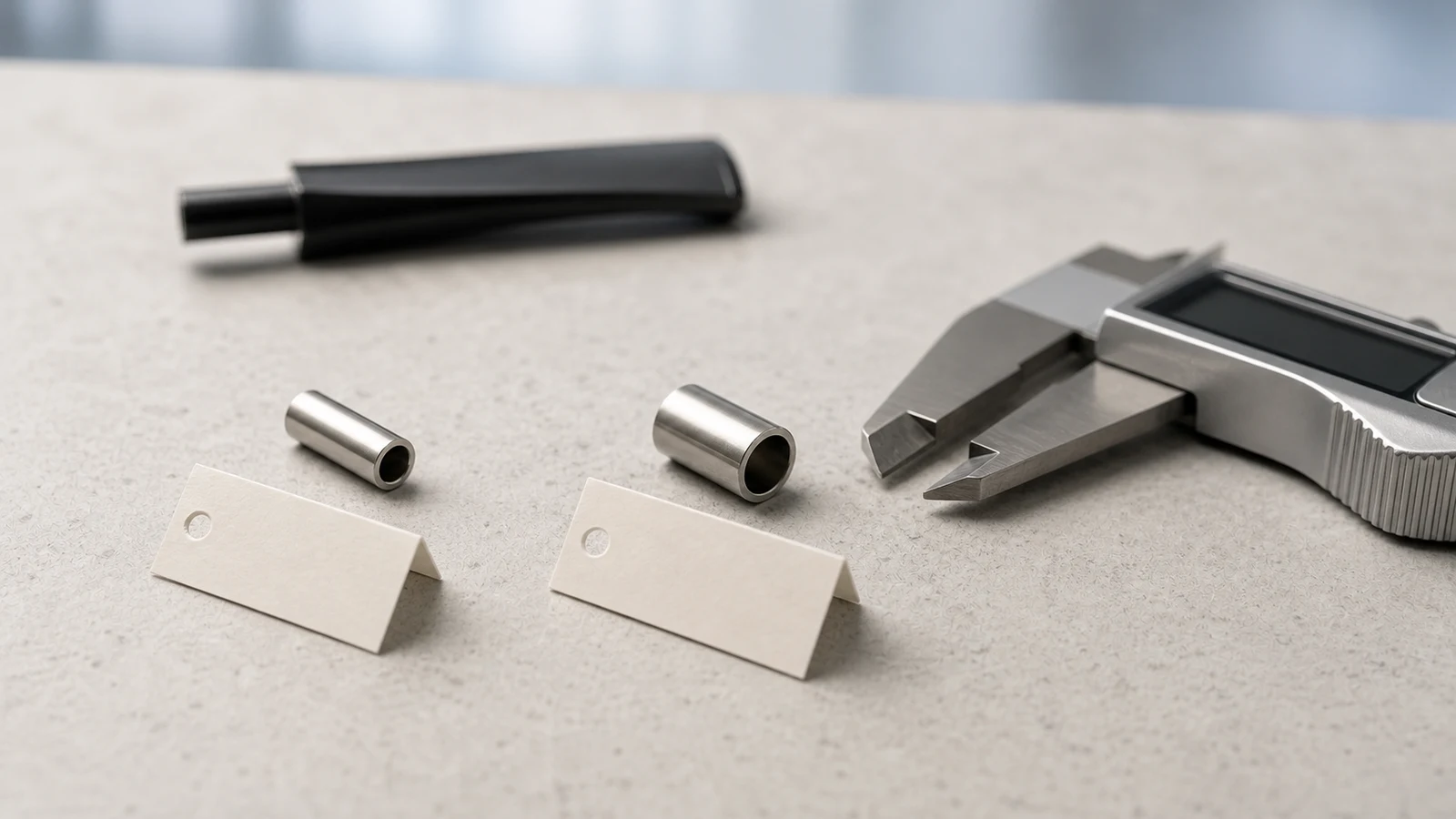
“3mm vs 9mm tobacco pipe filter” is usually the wrong comparison. In the specialist listings reviewed here, 9mm identifies a filter chamber, while 3mm identifies the draft hole left by a reducer fitted into that chamber. Those numbers describe different parts of one assembly, not two equivalent filter cartridges.
Start by finding the noun attached to each number: filter, filter chamber, adapter, reducer, draft hole, or airway. Then match the exact pipe and system to the maker's documented part. A diameter without that context cannot establish compatibility.
The short answer: name the component first
| Listing wording | Component it may describe | Decision it supports | What it does not prove |
|---|---|---|---|
| “9mm filter” | A replaceable component sold for a named 9mm system | Search within the exact documented system | Fit in every 9mm-labeled pipe |
| “9mm filter chamber” | The larger internal space intended for a filter or approved insert | The pipe has a stated filter-space configuration | Which third-party filter or reducer fits |
| “9mm-to-3mm adapter/reducer” | A part that occupies the filter chamber and leaves a smaller passage | A claimed non-filter configuration for a compatible pipe | A universal 3mm filter system |
| “3mm draft hole” or “3mm airway” | The internal passage named by the source | A passage measurement or reducer outcome | Replaceable-filter capacity |
| “3mm” with no noun | An ambiguous number | A question for the maker or seller | Anything about fit |
This distinction is visible in real retail documentation. Smokingpipes describes an 8deco 9mm-to-3mm adapter as reducing a 9mm filter chamber to a standard 3mm draft hole. Its separate 9mm-to-3mm reducer uses the same chamber-versus-draft-hole language. These are examples of the terminology, not proof that either reducer fits an unlisted pipe.
Why the original comparison is misleading
A filter chamber and a draft hole do different jobs in the geometry described by those listings. The chamber provides space for a specified component. The draft hole is the smaller passage through the adapter or pipe assembly. Saying “3mm vs 9mm filters” collapses those two objects into one category.
That category error leads to the wrong questions. “Which size is better?” is less useful than:
- Does the exact pipe have a documented filter chamber?
- Which replaceable filter system is named for it?
- Does its maker document use without the filter?
- If so, which exact adapter or reducer is approved?
- Does 3mm describe the reducer outlet, the airway, or a different part?
The broader filter sizes and compatibility guide explains filter families and part matching. This page stays focused on the 3 mm/9 mm terminology problem.
Current catalogs show 6mm and 9mm filter systems
VAUEN maintains separate manufacturer pages for the 6mm Dr. Perl junior and 9 mm Dr. Perl junior. Smokingpipes also lists multiple 6mm and 9mm replaceable products in its filters and adaptors catalog, while the 3mm wording appears on reducers that occupy a 9mm chamber.
That snapshot supports a narrow conclusion: 6mm and 9mm are documented replaceable-filter categories in those sources, whereas 3mm in the reviewed comparison examples is the reducer's draft-hole size. It does not prove that no manufacturer anywhere uses 3mm differently. If a pipe maker explicitly documents a 3mm component, preserve that maker's exact term and part number.
An Airway value is not filter compatibility evidence
On this site's product records, Airway: 3 mm, Airway: 9 mm, or a combined
airway value is source-supplied airway wording. It is not a verified filter
size, filter-chamber diameter, adapter specification, or compatibility claim.
Never use that catalog field to say that a pipe accepts a 3mm or 9mm filter.
The same boundary applies elsewhere. Product titles compress details. “Pipe 9mm,” “3mm adapter,” and “9/3 reducer” may help a retailer organize inventory, but the specification or description must still identify what the number modifies and connect it to the exact system.
Read four locations together:
- the product title;
- the filter or internal-system specification;
- the package-contents list;
- the maker/model compatibility statement.
If the title says 9mm but the body describes only an airway, do not promote that number into a filter claim. If a reducer appears in a photograph but the contents list omits it, do not assume it is included. If the accessory page names a brand or system, do not broaden it to every pipe with the same nominal diameter.
Verify a reducer as a model-specific part
A reducer is not generic empty space. Treat it as a component with identity, application, condition, and inclusion status. Record:
- pipe maker, model, and variant;
- stated filter-chamber system;
- reducer maker and part reference;
- the configuration the documentation says it creates;
- whether the reducer is included with the pipe;
- whether the current listing shows the same part from multiple angles;
- instructions for normal insertion and removal;
- any contradiction that still needs seller confirmation.
Do not use resistance as a fit test. Do not sand, wrap, drill, trim, or glue an unknown reducer to make the numbers appear to match. If the exact application is absent from the documentation, compatibility remains unknown.
Verify the complete configuration
A clear disassembled photo can show a filter, reducer, recess, or printed package. It can help confirm that a loose part was photographed. It cannot reliably show chamber depth, taper, retaining geometry, or the meaning of an unlabelled number.
Ask for a written answer that names the objects: “Does this exact pipe have a 9mm filter chamber, and is the pictured part the maker-specified reducer for a 3mm draft path?” That is more precise than “Is this pipe 3mm or 9mm?”
Use this five-line listing test before accepting any 3mm or 9mm claim:
- The 9mm number labels: ______.
- The 3mm number labels: ______.
- The exact pipe/system is: ______.
- The exact filter or reducer part is: ______.
- The source proving compatibility is: ______.
If the first two blanks name different components, this is not a same-category filter-size comparison. If the last three remain blank, the part match is not established.
Once the system is documented, the filter versus no-filter decision guide owns the choice between a specified filter configuration and a maker-approved reducer or adapter configuration. The filter sizes and compatibility Hub owns 6mm and 9mm filter families, component taxonomy, and the full compatibility record.
Frequently Asked Questions
Is a 3mm draft hole the same as a 3mm filter?
No. A draft hole is an internal passage. A replaceable filter is a component for a documented system. A shared number does not make them the same object.
What does a 9mm-to-3mm adapter do?
In the specialist-retailer examples reviewed above, it occupies a 9mm filter chamber and reduces the passage to a 3mm draft hole for a documented non-filter configuration. Confirm the exact pipe and adapter before applying that description to another system.
Does every 9mm pipe accept a 9mm-to-3mm reducer?
No universal fit is established. Match the reducer to the pipe maker, model, system, and part reference rather than relying on the two nominal diameters.
Can an Airway measurement prove filter compatibility?
No. An airway measurement describes the field it is attached to; it does not establish a filter chamber, replaceable-filter family, or approved reducer. Use maker/model documentation or explicit seller confirmation for the exact system and part.
The decisive detail is not that 3 is smaller than 9. It is that the numbers can name different components. Define each label first, then verify the pipe, filter, and reducer as one documented configuration. This site sells pipes, not filters or reducers; cited accessory pages document terminology only. Use the pipe product guide for the wider source-label and seller-question workflow.
Related posts
Product notes, store updates, and purchase guidance for the storefront.