Tobacco Pipe Filters: Sizes, Labels, and Compatibility Checks
Verify tobacco pipe filter size, adapters, condensers, measurements, and replacement fit without treating a listing label as proof of compatibility.
Written by
The Tobacco Pipe Editorial Team
The store editorial team reviews product facts, care boundaries, and buying guidance against the current catalog and source evidence.

Before ordering a tobacco pipe filter, identify the exact pipe and the named system, then match the maker-approved part or explicit compatibility statement. A nominal diameter is useful for finding candidates, but 6 mm or 9 mm alone does not prove fit.
Keep three component types separate: a filter is an insert identified for a documented filter system; an adapter or reducer changes a documented configuration; and a condenser is a differently named internal component. They are not interchangeable categories. This page is the filters Hub; it does not recommend a universal filter or claim that this site sells accessories. Return to the accessories guide Hub when the need is a cleaner, tool, stand, pouch, or kit rather than a filter system.
Filter, adapter, and condenser are different claims
| Component label | What the label may support | Evidence still required |
|---|---|---|
| Filter or maker-named insert | A replaceable or serviceable component for a stated system | Exact maker, system, nominal size, format, part reference, and instructions |
| Adapter or reducer | A part intended to change one documented assembly or configuration | Exact pipe application, resulting configuration, inclusion, and approved use |
| Condenser | A component the maker or seller calls a condenser | Whether it is removable, reusable, replaceable, and model-specific |
| Unlabelled loose piece | Only that a piece appears in the media | Identity, purpose, inclusion, dimensions, and compatibility |
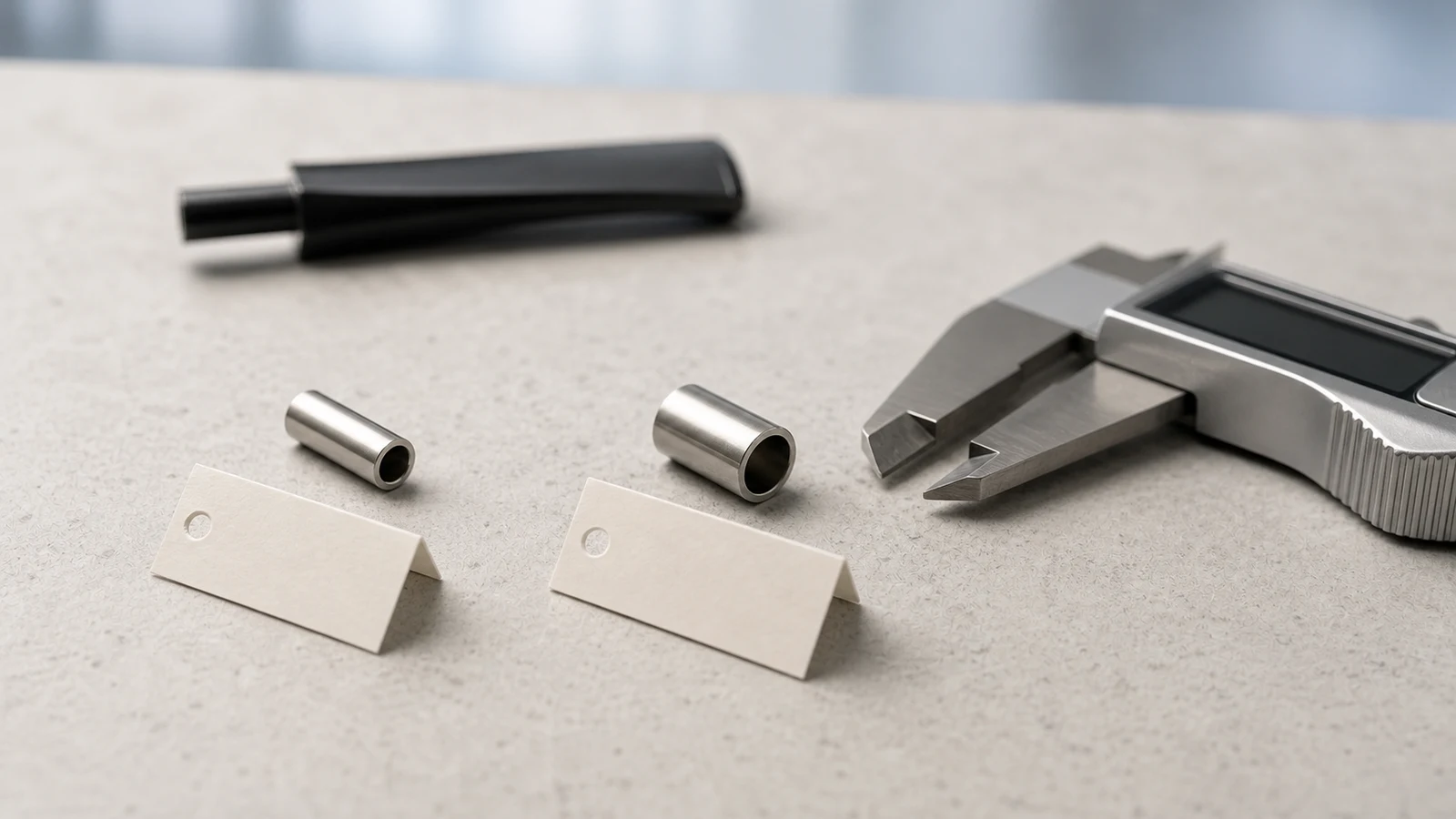
Do not identify a component from its color, shape, or position in a photograph. A visible cavity may be intended for a filter, adapter, condenser, tenon feature, or another part. The exact model documentation must name the system.
If a listing uses “cooling chamber” instead, use the cooling-chamber terminology guide before mapping that phrase to any filter-related component.
6 mm and 9 mm are documented systems, not universal fits
VAUEN publishes distinct manufacturer pages for its 6 mm Dr. Perl junior and 9 mm Dr. Perl junior products. Its filter background page also connects those sizes to the company's Conex system. These sources establish VAUEN's named systems, not interchangeability with every other 6 mm or 9 mm product.
Smokingpipes' filters and adaptors catalog likewise separates filters, adapters, balsa inserts, and other component families. Savinelli documents its Balsa System as a maker-specific insert system. Use these pages to understand vocabulary; use the exact pipe and part documentation to establish fit.
If 3 mm appears, first find the noun it modifies. In reviewed specialist listings, 3 mm often labels the draft hole left by a reducer in a 9 mm filter chamber, not a rival 3 mm disposable filter. The 9mm filter chamber vs 3mm draft hole guide owns that terminology problem.
Keep every claim attached to its source
Use this evidence order:
- Exact maker manual or model page: strongest source for the pipe's named system and approved parts.
- Maker accessory page: strong for the accessory's identity and stated application, but not for an unrelated pipe.
- Exact retailer listing or written seller confirmation: useful when it connects one pipe variant to one part reference.
- Packaging and received-item markings: supporting evidence that still needs an exact model relationship.
- Photograph, title, category, or nominal diameter alone: insufficient to establish hidden fit.
On this site's pipe records, an Airway value such as 3 mm or 9 mm is
source-supplied airway wording. It is not a verified filter-size field,
filter-chamber measurement, or compatibility statement. Never use that catalog
field to infer that a pipe accepts a 3 mm or 9 mm filter, adapter, or condenser.
Build one compatibility record
Before ordering, record:
- exact pipe maker, model, variant, and current condition;
- maker-stated filter system or explicit non-filter configuration;
- filter, adapter, or condenser maker and part reference;
- all supplied dimensions, format, and construction details;
- whether the part is included, optional, or sold separately;
- installation, removal, and replacement instructions;
- the source URL or written confirmation and the date checked.
If the decisive system or part reference is missing, ask: “Is this exact part approved for this exact pipe model and variant?” Do not substitute a shared diameter for that answer. Do not trim, wrap, sand, drill, glue, or force a part to create a fit.
Choose the next filter guide
Use filter vs no filter when the system is known and the remaining decision is between a documented filter configuration and a maker-approved non-filter configuration. Use 9mm filter chamber vs 3mm draft hole when a listing appears to compare those two numbers as though they name equivalent filters.
Frequently asked questions
Should you use a filter in a tobacco pipe?
First confirm whether the exact pipe has a documented filter system and which parts its maker specifies. The choice between approved configurations belongs in the filter-vs-no-filter guide; this Hub does not promise a health, performance, or preference outcome.
What is the most common tobacco pipe filter size?
Current manufacturer and specialist catalogs document both 6 mm and 9 mm systems. Popularity does not establish fit. Use the exact pipe's named system and compatible part reference.
How often should a tobacco pipe filter be replaced?
Follow the instructions for the exact maker, filter material, and system. Do not create a universal schedule from another brand or a search-result summary.
Filter compatibility is a sourced relationship between an exact pipe and an exact part. Name the component, identify the system, retain the claim source, and leave fit unconfirmed when any decisive field is missing. The pipe product guide provides the broader checklist for source labels, dimensions, condition, and seller questions.
Related posts
Product notes, store updates, and purchase guidance for the storefront.