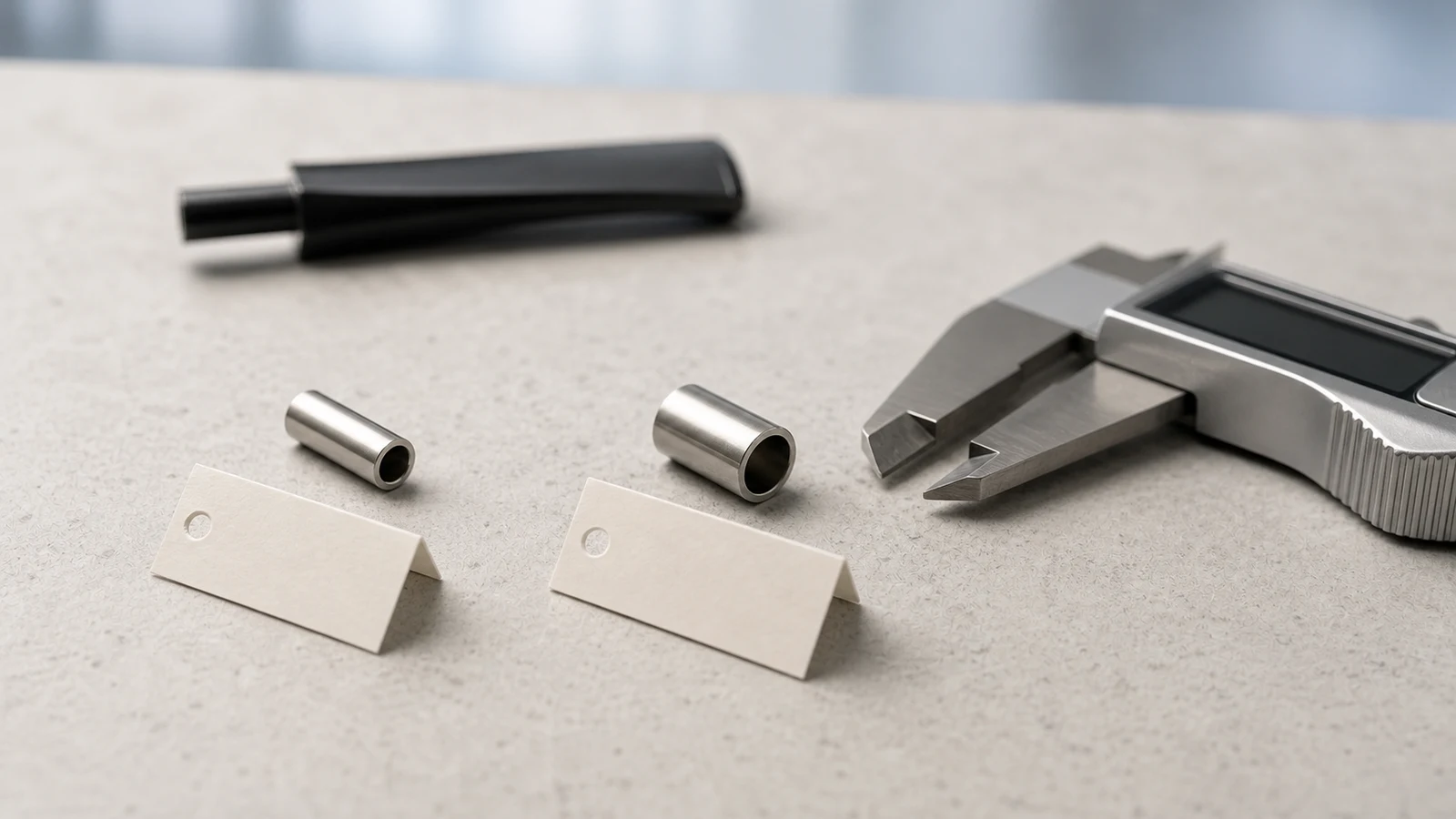
Tobacco Pipe Filter vs No Filter: What to Verify First
Compare filtered and unfiltered tobacco pipe listings by confirmed design, filter size, adapters, replacement availability, and unknown fit.
Written by
The Tobacco Pipe Editorial Team
The store editorial team reviews product facts, care boundaries, and buying guidance against the current catalog and source evidence.
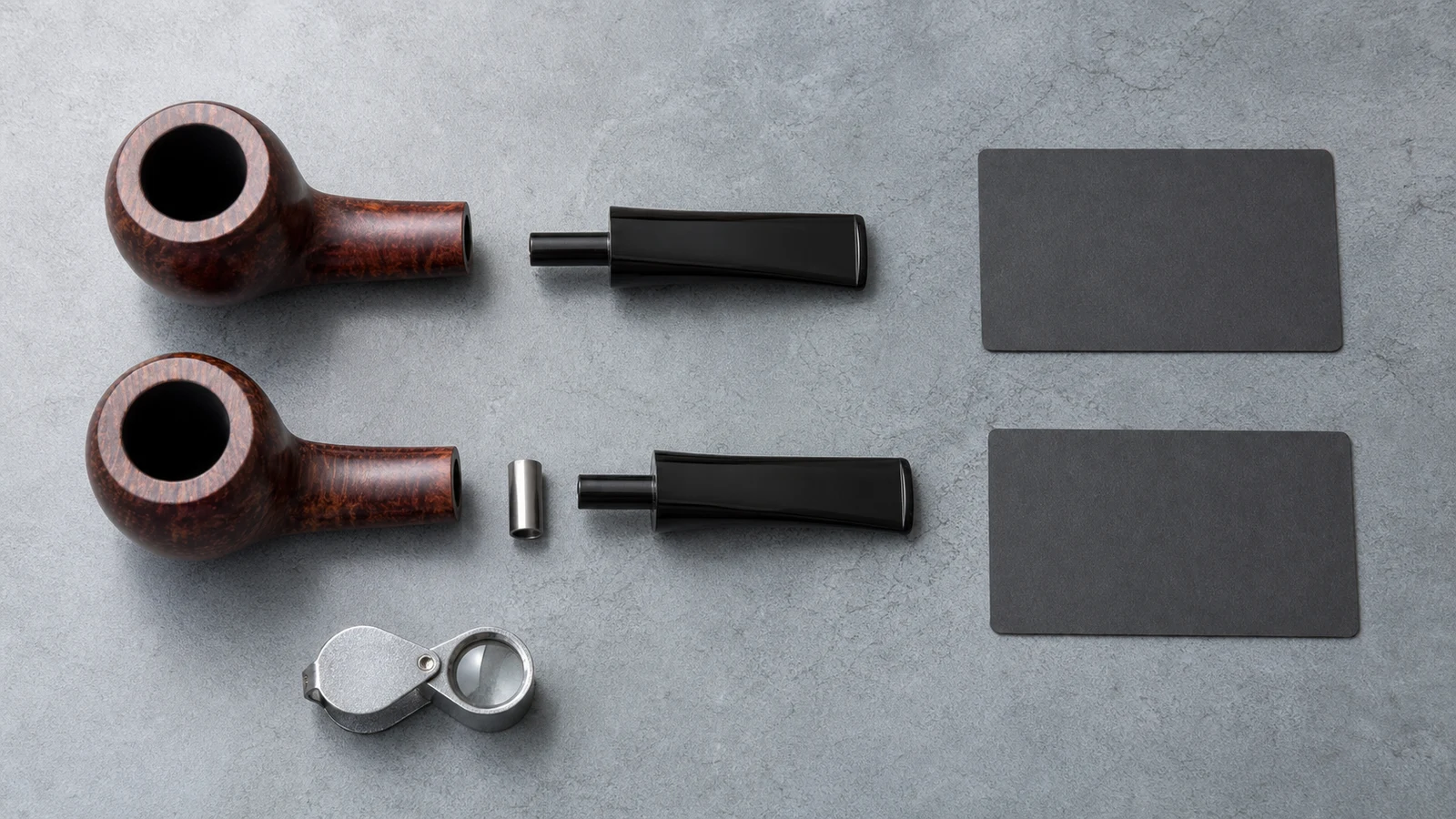
The useful tobacco pipe filter vs no filter decision starts with three possible configurations: a pipe documented for a replaceable filter, a pipe documented for use without one, or a filter-chamber pipe documented to accept a specific adapter. These are construction and parts-management choices; none is universally “better.” If the listing does not establish which applies, configuration is unknown.
A source label, seller confirmation, or manufacturer specification is stronger evidence than a photograph. Do not infer filter support from a wide-looking shank, a removable stem, or an airway number. Those details may describe other parts of the pipe and do not prove that a particular filter will fit.
Filtered and non-filtered designs at a glance
| Listing situation | What it supports | What remains unconfirmed |
|---|---|---|
| A filter type and nominal size are stated | The seller represents the pipe as using that named system | Exact fit of a third-party filter, included quantity, and replacement availability |
| “Filter pipe” appears with no size | The listing claims some filter support | Filter format, dimensions, brand-specific fit, and package contents |
| “Non-filter” or “no filter” is stated | The seller represents it as a non-filter design | Internal measurements and whether any optional adapter exists |
| An adapter is named for the model | The listing claims a supported non-filter configuration for that filter-chamber pipe | Whether the pictured adapter is included and whether another model uses the same part |
| No filter information is supplied | Nothing reliable about filter support | Design, size, adapter, included parts, and compatibility |
This table is a verification guide, not a promise about a particular product. Individual listings can use inconsistent terminology, so the exact product page and a seller response should control the decision.
Start with the supported design
A filtered pipe is built around a stated filter arrangement. A non-filtered pipe is presented for use without that component. Some listings describe an adapter or converter that changes how the connection is configured, but the word “adapter” alone does not explain its dimensions or purpose.
This is not merely theoretical catalog language. A specialist retailer's Savinelli 6 mm adapter listing names a removable part specifically for 6 mm Savinelli pipes. Its broader filters and adaptors catalog separates adapters from replaceable filters. Those examples show why “has an adapter” must be tied to the exact system; they do not prove another pipe can use the same part.
VAUEN's separate manufacturer pages for its 6 mm and 9 mm filter lines provide another check: even a familiar diameter label belongs to a documented system, not to an automatic cross-brand fit rule.
Look for clear wording in the specification area rather than relying only on the product title. Useful fields include:
- filter support: yes, no, optional, or not stated;
- the nominal filter size or named system;
- whether a removable adapter is required;
- whether that adapter is included;
- a manufacturer or model reference, when available;
- close-up images of supplied parts, preferably disassembled.
If a listing says only “3mm” or “9mm,” read the label around that number. It may identify an airway measurement, a product family, or a claimed filter system. An airway figure is not, by itself, proof of filter capacity or fit.
Filter size is a label, not a compatibility guarantee
Nominal size helps narrow the search, but it is not a complete technical drawing. Filters can differ in length, end shape, construction, tolerances, and brand-specific design even when a familiar number appears on the package.
For that reason, avoid the shortcut “same number means compatible.” Instead, match the pipe's stated system to the accessory maker's stated application. When the listing does not provide enough information, ask the seller for the supported filter type and the relevant product documentation. Do not force a component into an unknown opening to test the assumption.
The same caution applies when comparing two pipes. Similar silhouettes do not mean they use the same internal arrangement. A stem may look thick enough to hold a filter while being constructed differently inside. Conversely, a slim profile does not establish a non-filter design.
Treat adapters as separate parts to verify
An adapter can be easy to overlook because it may sit inside the assembled pipe or appear as a small loose piece in one gallery image. Before relying on it, confirm four separate facts:
- Purpose: What configuration does the seller say the adapter supports?
- Fit: Is it specified for this exact pipe or model?
- Inclusion: Is it part of the package, or merely shown for reference?
- Condition: If condition is relevant, does the listing address that specific part?
An adapter from another pipe should not be treated as interchangeable based on appearance. Small differences at the stem and shank connection matter, and ordinary product photos rarely establish those dimensions.
What product photos can confirm
Photos are most useful for visible inventory and broad configuration. A clear disassembled image may show a removable stem, a recess, or a separate adapter. Multiple angles may help you determine whether the same components appear throughout the gallery.
Photos cannot reliably confirm:
- the internal diameter or depth of a hidden opening;
- the precise filter format supported;
- the fit of a third-party filter;
- whether an airway label also refers to a filter system;
- whether every pictured loose item is included;
- the complete internal condition of the stem or shank.
Captions and specification fields provide the claim; photographs provide visual context. When the two seem inconsistent, pause and ask for clarification rather than choosing whichever interpretation is more convenient.
How to decide between filter and no filter
Make the decision in two stages. First, identify the pipe configuration that is actually documented. Second, decide whether you want to manage the parts and replacement requirements associated with that configuration. This keeps a preference question separate from a fit question.
For a filter-design listing, review the named system, availability of the exact compatible component, replacement schedule supplied by its maker, and whether an adapter changes the setup. For a non-filter listing, verify that the seller explicitly uses that description instead of assuming that silence means no filter.
This article does not assign performance or health outcomes to either design. Those claims would require product-specific evidence and are not established by a filter label. A conservative buying comparison should stay with facts the listing can support: design, nominal size, included parts, and confirmed compatibility.
Use this compact decision matrix after the product configuration is verified:
| Decision factor | Documented filter system | Documented non-filter design | Filter chamber with documented adapter |
|---|---|---|---|
| Replaceable part needed | Exact filter format | None identified | Exact adapter, plus filter only when using the filter configuration |
| Main evidence | Maker/model and filter reference | Explicit non-filter specification | Maker/model and adapter reference |
| Package question | Are compatible filters included? | Are any internal inserts present? | Is the correct adapter included? |
| Ongoing check | Maker's replacement instructions and part availability | No filter stock to track | Keep the model-specific adapter identified and available |
For the full component taxonomy, use the tobacco pipe filter sizes and fit guide. If the listing says “9 mm to 3 mm,” the 3 mm versus 9 mm label explanation shows why that wording usually compares a filter chamber with a reducer outlet, not two equivalent filter cartridges.
A pre-order filter checklist
Use this checklist before ordering a pipe when filter configuration matters:
- The listing clearly says filtered, non-filtered, optional, or unknown.
- The filter size or named system is stated in the correct specification field.
- Any number is identified as filter-related rather than merely an airway measurement.
- The need for an adapter is explained.
- The listing states whether the adapter or filter is included.
- The accessory maker identifies the intended application.
- Product-specific questions have been answered by the seller.
- Current price, stock, condition, shipping, and returns have been rechecked separately.
If several boxes remain empty, record the configuration as unknown. The site's product guide offers a broader process for separating visible features from details that require listing or seller confirmation.
The current catalog does not sell filters or adapters. These external examples are cited only to explain systems and questions to verify; they are not a claim that an accessory is available here.
Frequently Asked Questions
Do tobacco pipes need filters?
Not every pipe is presented as a filter design. The correct answer depends on the construction and specification of the individual pipe. Check for an explicit filter or non-filter label and do not interpret missing information as either one.
Can I tell whether a pipe takes a filter from photos?
Usually not with confidence. A disassembled photo may show a recess or adapter, but it does not establish exact dimensions, the named system, or third-party compatibility. Use photos to support, not replace, the written specification.
Does a 3mm or 9mm airway label prove filter compatibility?
No. An airway measurement describes an internal passage as represented by the source. It does not automatically identify a filter system. Confirm what the number labels on the individual product page.
What should I ask the seller before ordering?
Ask whether the exact pipe is filtered or non-filtered, which filter system it supports, whether an adapter is required and included, and whether the seller can provide model-specific documentation. Also confirm package contents rather than assuming every photographed item is included.
Is a filter adapter interchangeable between pipes?
Do not assume so. An adapter should be matched to the pipe or model for which it is specified. Visual resemblance and a shared nominal number are not enough to prove fit.
The useful conclusion is simple: choose only after the pipe's documented configuration is clear. When the listing leaves the system, size, or adapter status uncertain, ask for confirmation or treat compatibility as unknown.
Related posts
Product notes, store updates, and purchase guidance for the storefront.