How to Choose a Tobacco Pipe Stand
Choose a tobacco pipe stand by capacity, contact points, dimensions, stability, and the exact pipe profile it must support.
Written by
The Tobacco Pipe Editorial Team
The store editorial team reviews product facts, care boundaries, and buying guidance against the current catalog and source evidence.
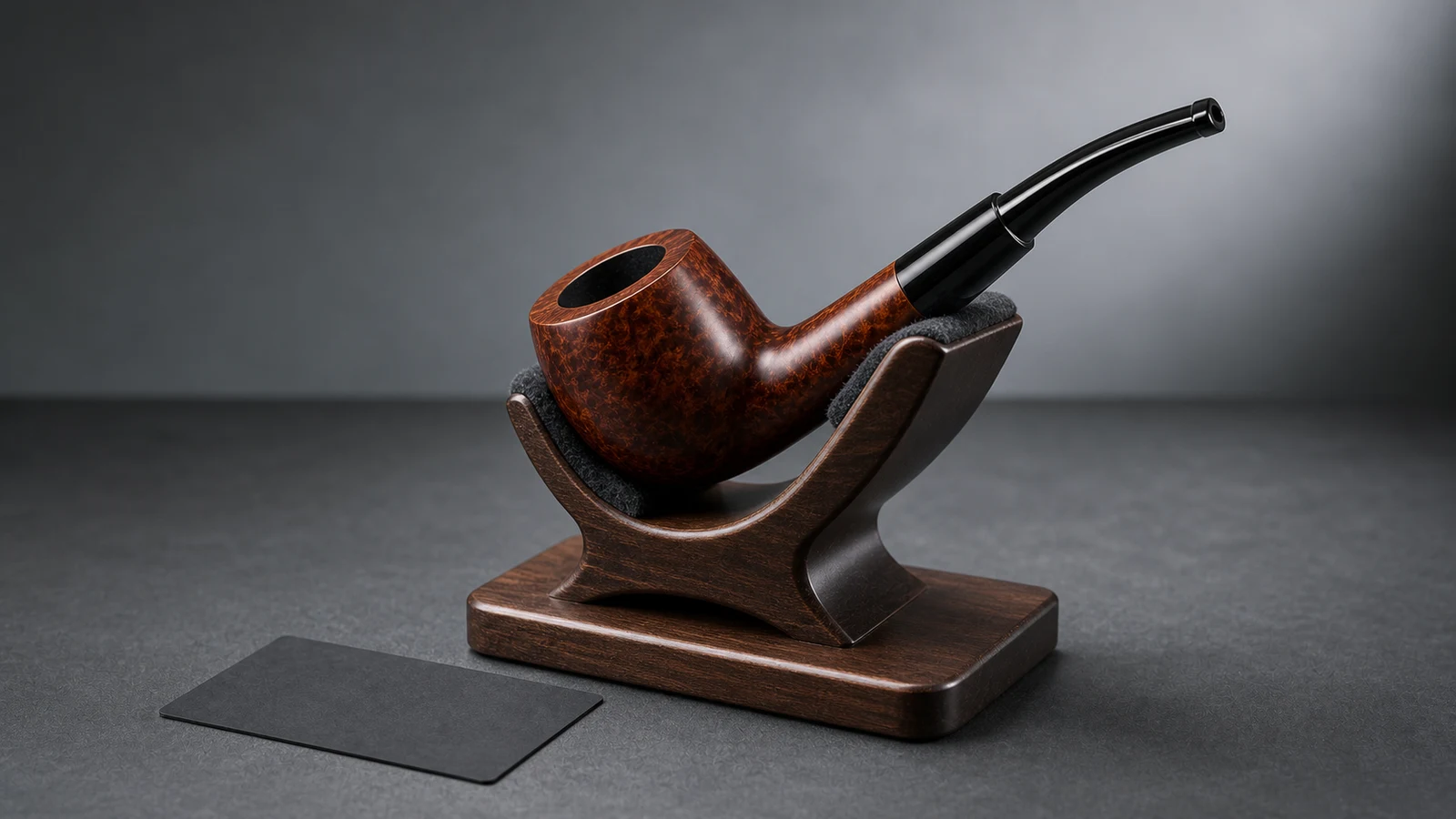
Choose a tobacco pipe stand by mapping every place where the stand will touch the pipe, then comparing the usable stand dimensions with the pipe's exterior measurements. Capacity comes after fit: a three-position rack can still be too narrow for three broad bowls, and a single rest can place its upper support at the wrong point for a deeply bent pipe.
This page is a measurement worksheet for evaluating a stand sold elsewhere; The Tobacco Pipe does not currently offer stands. The catalog examples below show why a seller needs to provide more than a slot count or a staged photo.
Start with contact points, not the stand label
A stand usually supports a pipe in two zones. The lower zone may be a bowl dish, notch, ring, or folding rest. The upper zone may meet the shank or stem, or it may not exist at all. Record the geometry of both zones before comparing materials or finish.
| Fit question | Measure on the pipe | Ask for on the stand | Pass condition |
|---|---|---|---|
| Lower support | Maximum bowl width, bowl height, and the surface likely to enter the cradle | Usable recess width and depth, not the outside size of the base | The bowl reaches a stable contact area without being forced against an edge |
| Upper support | Height and width of the shank or stem at the likely contact point | Support height, opening width, depth, and angle | The intended pipe section reaches the support without side pressure |
| Bend clearance | Side-profile envelope from the bowl through the stem | Horizontal and vertical clearance between supports | The curve clears the structure rather than hanging on an unintended point |
| Adjacent positions | Maximum width of each bowl and the widest part of each profile | Center-to-center spacing and clear gap between positions | Neighboring pipes do not have to touch to occupy the stated capacity |
| Loaded footprint | Overall length, height, and likely overhang | Base width, depth, assembled height, and permitted orientation | The loaded pipe remains within the intended placement area |
Do not add an invented tolerance to incomplete measurements. If a stand seller publishes only its overall width, that number does not reveal the diameter of a bowl recess or the clear width of an upper slot.
Use real pipe dimensions as worksheet inputs
Three current catalog records illustrate different fit problems. Their dimensions are translated, source-reported approximate measurements and have not been independently verified.
| Catalog example | Source-reported exterior dimensions | What those figures let you ask | What remains unknown |
|---|---|---|---|
| Long Churchwarden | 340 mm overall length; 40.9 mm bowl outer diameter | Is there enough front-to-back clearance for the long profile, and is the lower cradle wider than the stated bowl diameter? | Support-point height, actual overhang, balance, shank width, and stand compatibility |
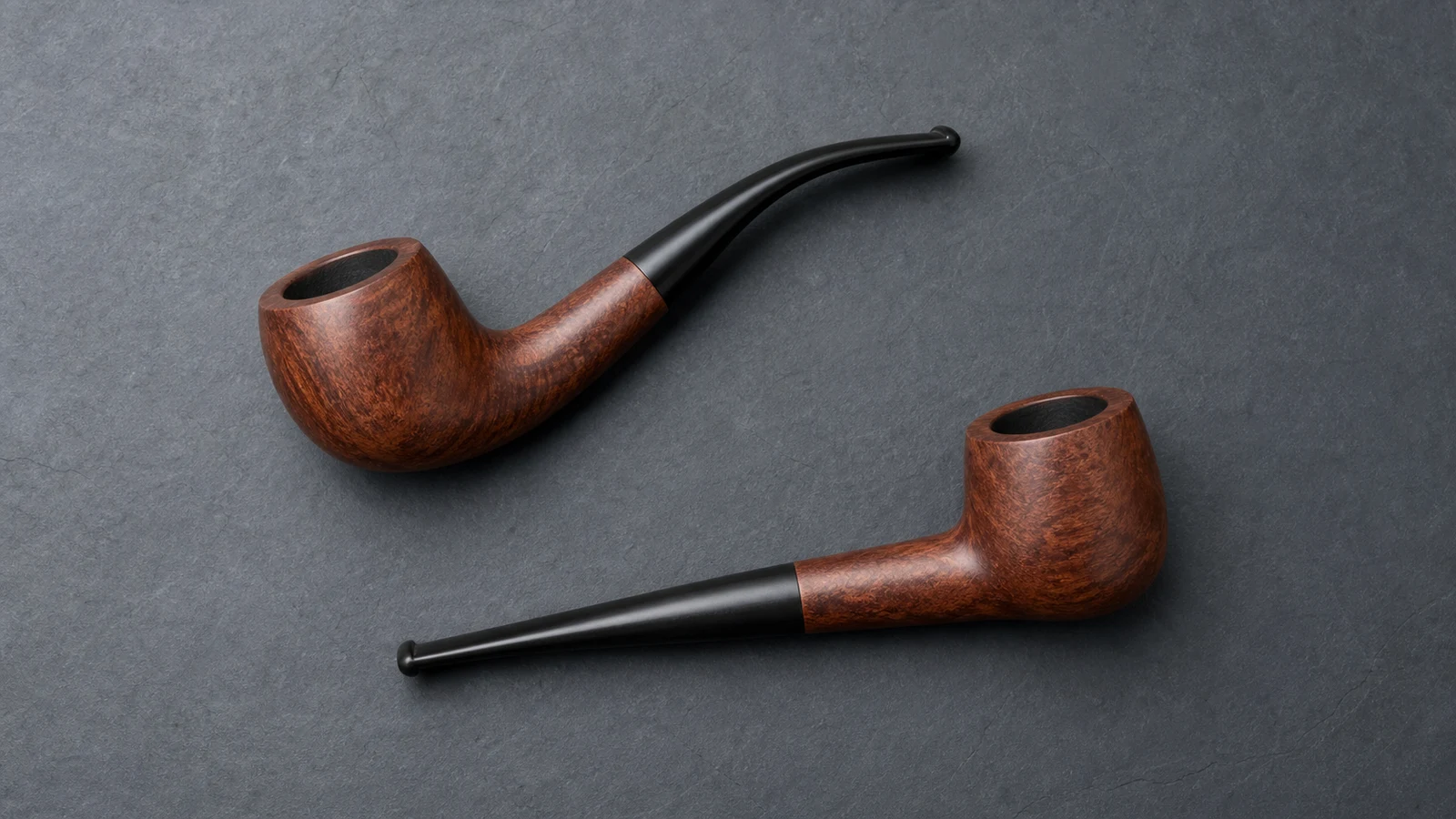
| Devil Note Full Bent | 115.1 mm overall length; 40.5 mm bowl outer diameter; 50.6 mm bowl height | Does the upper support meet the curved profile at the intended point, and is there clearance below it? | The full side-profile envelope, center of gravity, contact angle, and stand compatibility |
| Large Acorn Bent | 140 mm overall length; 49.2 mm bowl outer diameter; 46.3 mm bowl height | Is the bowl recess and the gap to the next position wide enough for a nearly 50 mm exterior diameter? | Base contour, exact contact patch, support height, and stand compatibility |
These are examples of how to populate the pipe side of the worksheet, not proof that any named stand fits. Overall length and maximum bowl diameter do not identify where a stand will make contact. A seller still needs to provide the corresponding stand measurements or test the exact profile.
The pipe-shape overview helps name the exterior profile, while the bent-versus-straight guide explains why bend labels are broad catalog groups rather than clearance specifications.
Work from the stand drawing back to the pipe
If a listing includes a dimension drawing, copy each usable measurement into a two-column note. Keep exterior dimensions separate from clearances:
- Record the inside width and depth of the bowl cradle.
- Record the upper opening width, its height above the lower contact point, and any rear clearance.
- For a rack, record the center-to-center spacing and the smallest clear gap.
- Note any lip, rail, hinge, or fastener that projects into those spaces.
- Compare the intended contact locations with the exact pipe, not with the closest shape shown in a product photograph.
The 8deco three-pipe stand listing is a useful example of why the two columns matter. It describes three bowl rests plus a rear portion that holds stems upright. That establishes two support zones, but the position count alone does not supply the usable cradle size, rear opening, support height, or spacing needed to clear every profile.
When a dimension is absent, ask a concrete question: “What is the clear width of each bowl rest at its narrowest point?” is more useful than “Will it fit a large pipe?” For an unusual profile, send the stand seller the pipe's stated dimensions and a true side view, then ask where the design is intended to make contact.
Capacity is a geometry claim
For a multi-pipe rack, stated capacity is the number of intended positions, not the number of arbitrary pipes it will hold. Fill the rack on paper before ordering: assign one actual pipe to each position, put the widest neighbors next to each other, and compare their envelopes with the seller's spacing.
Check whether the first and last pipes extend beyond the base, whether bowls share a lower shelf, and whether the upper rail forces stems into parallel positions. A staggered layout may create more apparent room in a front photo than exists at the bowl level. A top or dimensioned plan view is more useful.
Also separate capacity from package contents. Missouri Meerschaum's six-pipe wood stand describes a six-position display and says the photographed pipes are not included. The number establishes the intended position count for that product; it does not establish usable fit for six pipes of any dimensions.
Match the worksheet to the stand mechanism
Different stand mechanisms create different missing measurements:
- A fixed upright stand needs lower-recess size, upper-support height, opening width, and lean angle.
- A low single rest needs the span and contour of its contact surfaces plus the expected overhang.
- A folding stand needs its usable opening in the deployed position, contact geometry, and hinge behavior.
- A wall rack needs the same pipe clearances plus mounting instructions, wall suitability, fixings, and distance from the wall.
- A stand with a jar or storage compartment needs separate usable dimensions and a written package list; a prop in the photo is not automatically included.
Missouri Meerschaum describes its folding stand as using a swivel tension hinge. That is a different support system from the fixed bowl-rest and rear-rail layout above, so the same stand checklist cannot stop at “one pipe” or “three pipes.”
Treat stability as a loaded configuration
A wide-looking base is not a stability specification. Note the base footprint, assembled height, stand weight if supplied, intended loading pattern, feet or pads, and the flat surface where it will sit. For a rack, ask whether the maker specifies an order for loading positions or any restriction on uneven loading.
Photos can show the broad footprint and support arrangement. They cannot show the loaded center of gravity, hidden fasteners, surface grip, or how a different pipe changes the balance. Keep placement away from edges and follow the maker's assembly or mounting instructions rather than converting a studio image into a stability promise.
Copy this stand-fit worksheet
Fill every blank that controls fit before ordering:
| Field | Pipe value | Stand value | Confirmed by |
|---|---|---|---|
| Maximum bowl width | ___ | Lower clear width: ___ | Product page / seller reply |
| Bowl height and lower contact location | ___ | Recess depth and shape: ___ | Dimension drawing / seller reply |
| Upper contact location and width | ___ | Support height and opening: ___ | Dimension drawing / seller reply |
| Full bend or side-profile envelope | ___ | Clear vertical/horizontal space: ___ | Side view / seller reply |
| Overall length and likely overhang | ___ | Base depth and permitted overhang: ___ | Product page / instructions |
| Neighbor clearance, if applicable | ___ | Clear gap and center spacing: ___ | Plan view / seller reply |
| Assembly and loaded placement | ___ | Footprint, hardware, loading notes: ___ | Instructions |
Finish with the seller's current package contents and return terms. Once fit is documented, the pipe storage guide can help separate a display-support decision from the broader storage environment. The useful outcome is not a “universal” stand claim; it is a completed set of matching measurements for one pipe and one stand.
Related posts
Product notes, store updates, and purchase guidance for the storefront.