How Much Is a Good Tobacco Pipe? Reading Price Without Guessing Quality
See source-reported price bands and percentiles from 150 July 2026 catalog records without treating price as proof of tobacco pipe quality.
Written by
The Tobacco Pipe Editorial Team
The store editorial team reviews product facts, care boundaries, and buying guidance against the current catalog and source evidence.
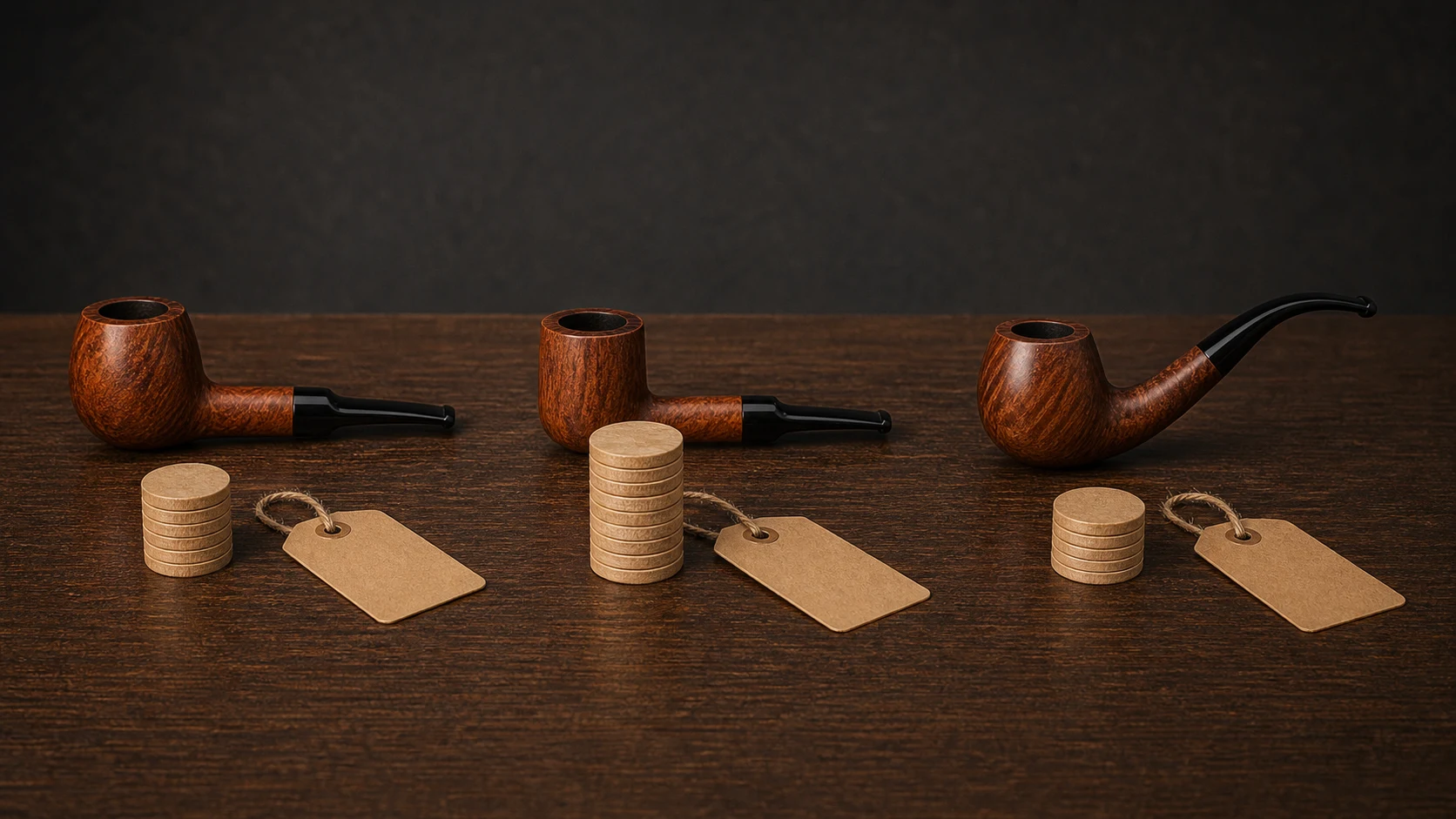
There is no universal price that makes a tobacco pipe “good.” In this site's 150-record catalog-import snapshot generated on July 16, 2026, the source-reported USD prices ran from $99 to $625. Just over half of the records were priced at exactly $99, and three quarters were $145.83 or less. Those figures describe one dated catalog; they are not a market benchmark or a quality scale.
The practical answer is therefore two-part: this snapshot places most of its listings between $99 and $199.99, but a responsible choice still depends on what the exact price is attached to. Compare the source-reported material, condition, dimensions, maker or origin, included contents, delivery, tax, and return terms. None of those source claims has been independently verified by this price analysis, and every live price can change.
What the 150-record price distribution actually shows
The table below uses all 150 regular-price values in the committed import fixture. The bands are descriptive groupings, not recommended budgets.
| Source-reported price band | Records | Share of snapshot |
|---|---|---|
| Exactly $99 | 76 | 50.7% |
| Above $99 and below $125 | 33 | 22.0% |
| $125–$199.99 | 24 | 16.0% |
| $200–$299.99 | 12 | 8.0% |
| $300 and above | 5 | 3.3% |
The nearest-rank cut points add another useful view: the 25th percentile and median were both $99, the 75th percentile was $145.83, and the 90th percentile was $207.92. The $625 maximum is a single upper-end record, not evidence that $625 is a normal price or that the item is better than records below it.
Because 76 records share the same $99 price, the median does not describe a smooth middle of the range. It exposes a large price cluster. A smaller number of higher records stretch the range upward, so quoting only “$99 to $625” would overstate how evenly the catalog is distributed.
Use the live pipe shop to check current displayed prices. Recheck the individual product page and checkout before payment, because an article cannot promise future price, stock, shipping, tax, or final total.
Five cross-band examples from the same snapshot
These examples deliberately cross several price levels. Prices and descriptive details below are source-reported fields captured in the July 16 import; the product links are where current price, stock, description, and checkout state must be rechecked.
| Snapshot example | Source-reported price | What the source record says | What the price still does not prove |
|---|---|---|---|
| Prince Apple | $99 | Spanish-imported briar burl, new and unused, plus approximate dimensions | Independent material, condition, or measurement verification |
| Large Billiard Straight | $124.58 | Spanish-imported briar burl with flame- and birdseye-grain notes | Why it costs $25.58 more than the $99 example |
| Faceted Volcano Straight Freehand | $161.67 | Spanish-imported briar burl, Cumberland stem, grain notes, and approximate dimensions | Better engineering, comfort, condition, or value |
| Prince Apple Slightly Bent | $245 | Spanish-imported briar burl, Cumberland stem, grain notes, dimensions, and weight | That every stated feature matters to a particular buyer |
| Classic | $625 | Only a source title and one supplied product image were available in the import | Material, dimensions, origin, condition, compatibility, or superior quality |
The $625 record is the clearest warning against reading price as evidence. It is the maximum in this snapshot while also having the least complete source record of these five examples. That does not make it poor; it means the import does not contain enough verified information to explain the premium.
What price can and cannot tell you
| Price can tell you | Price cannot prove by itself |
|---|---|
| The current amount displayed for a specific product | That the material is briar unless the product page says so |
| Whether a candidate is inside your initial budget | New, used, restored, or estate condition |
| The difference between two displayed listing prices | Maker, country of origin, or handmade status |
| Whether you should investigate the reason for a premium | Exact dimensions, weight, fit, or filter compatibility |
| A starting point for comparing the catalog | Included accessories, internal condition, or performance |
The right-hand column is where unsupported assumptions often appear. An expensive pipe may have detailed source-backed reasons for its price, but the price itself is not that evidence.
Look for verified differences behind the number
When two pipes have different prices, compare the same fields on both pages:
- Material description: Is briar or another material explicitly stated?
- Condition: Is the item new, used, restored, estate, or still unverified?
- Dimensions and weight: Are the numbers actually supplied?
- Maker and origin: Are identities and locations stated by the source?
- Shape and finish: Which labels are stated, and what do the photos show?
- Construction or feature labels: Are terms such as handmade, army mount, bamboo shank, 3mm, 9mm, or system explained?
- Included items: Does the description name a pouch, stand, box, tool, or other accessory?
If a more expensive product supplies stated differences that matter to you, the premium may be understandable. If it supplies only a more dramatic title, keep investigating rather than filling in the gaps.
Condition changes the meaning of a price
Condition is a separate fact, not something to estimate from price. A low price does not prove that a pipe is used or damaged. A high price does not prove that it is new, restored, or pristine.
Read the exact condition field and notes. Product photos may show visible surfaces, but they do not reveal complete internal condition, cleaning history, repair history, or stem fit. If a condition term is missing, ask the seller to state it before using price as part of the comparison.
Use the condition-label guide when two prices are attached to different or missing condition descriptions, and the photo-inspection checklist when imagery appears to imply more than the text states.
For used, restored, or estate items, the product page should make its own factual claims. Do not transfer a condition description from another item, even if the two pipes look similar.
Included items can distort a quick comparison
One product page may show a pipe alone. Another may show a box, pouch, stand, or tool. The second photograph does not necessarily mean every visible object is included.
Compare package contents separately from product price:
- Read the written “included” or “package contents” field.
- Distinguish product photography from editorial props.
- Check whether an accessory is optional, bundled, or sold separately.
- Check compatibility when a stand, pouch, filter, or tool is included.
- Ask when the photograph and written contents appear inconsistent.
This matters especially for “starter kit” searches. The phrase is not a standardized inventory list, and it does not guarantee value unless the actual contents and their relevance are clear.
Create a complete budget
A sensible budget includes more than the headline price. Before choosing a limit, identify which additional costs or decisions apply to the exact order.
Use this budget checklist:
- current pipe price and currency;
- quantity;
- confirmed included items;
- separately needed accessories, if any;
- shipping method and charge;
- applicable tax;
- final checkout total;
- return conditions that may affect your decision.
This mirrors the FTC's online-shopping guidance, which recommends reading the whole product description, calculating total cost including delivery and fees, and checking delivery, return, and refund terms.
Do not invent an accessory list from a generic guide. Your needs depend on the selected product and verified compatibility. The site's product guide can help you identify which facts to confirm without prescribing one universal bundle.
Avoid three misleading price shortcuts
“The cheapest pipe is the beginner pipe”
Low price may fit a budget, but it does not establish product clarity, condition, dimensions, compatibility, or included items. Compare evidence, not just rank order. The beginner buying matrix shows how to make that comparison without naming a universal winner.
“The highest price means the highest quality”
A premium may reflect verified maker information, construction, finish, scarcity, or other factors, but those reasons must be stated. Price cannot be used as a substitute for them.
“All pipes in one shape should cost about the same”
Shape is only one catalog attribute. Two Billiard, Apple, or Freehand listings can differ in many stated details. Compare individual products rather than assigning a fixed value to a shape name.
A price-evidence scorecard
Before treating a displayed price as decision-ready, answer yes or no:
- Is this the current product page rather than a screenshot or old article?
- Is the currency explicit?
- Is condition stated?
- Are the material and source-labeled features clear?
- Are decision-critical dimensions supplied?
- Are included items named in writing?
- Is filter compatibility confirmed if it matters?
- Are stock and quantity current?
- Can checkout show shipping, tax, and total for the destination?
A “no” does not automatically disqualify the product. It tells you which question must be answered before comparing value.
Frequently asked questions
How much is a good tobacco pipe?
No universal amount defines “good.” The July 16, 2026 import snapshot spans $99 to $625, but the right amount depends on verified product differences and your budget. Use live prices and current listing facts rather than a fixed rule.
Does a higher price prove better quality?
No. It may prompt you to look for additional verified details, but it cannot prove material, condition, maker, origin, construction, or performance by itself.
Why are the 25th percentile and median both $99?
Because 76 of the 150 imported records—50.7% of the snapshot—had a source-reported price of exactly $99. The distribution has a large lower-price cluster rather than 150 evenly spaced values.
Does the $625 maximum identify the best pipe in the catalog?
No. That record had only a source title and one supplied image in the import. The price does not establish material, dimensions, origin, condition, compatibility, or comparative quality.
How current are these price bands?
They describe the import snapshot generated on July 16, 2026. Use the live catalog and the exact product page to recheck current price, currency, stock, shipping, tax, returns, and checkout total.
Price becomes useful only when it is attached to evidence. Compare the facts behind the amount, label unknowns honestly, and judge value according to the differences that matter to your own decision.
Related posts
Product notes, store updates, and purchase guidance for the storefront.