Carved Briar Tobacco Pipes: Reading the Visible Detail
Inspect carved briar pipe photos for visible relief, continuity, and camera-angle limits without inferring maker, material grade, or performance.
Written by
The Tobacco Pipe Editorial Team
The store editorial team reviews product facts, care boundaries, and buying guidance against the current catalog and source evidence.
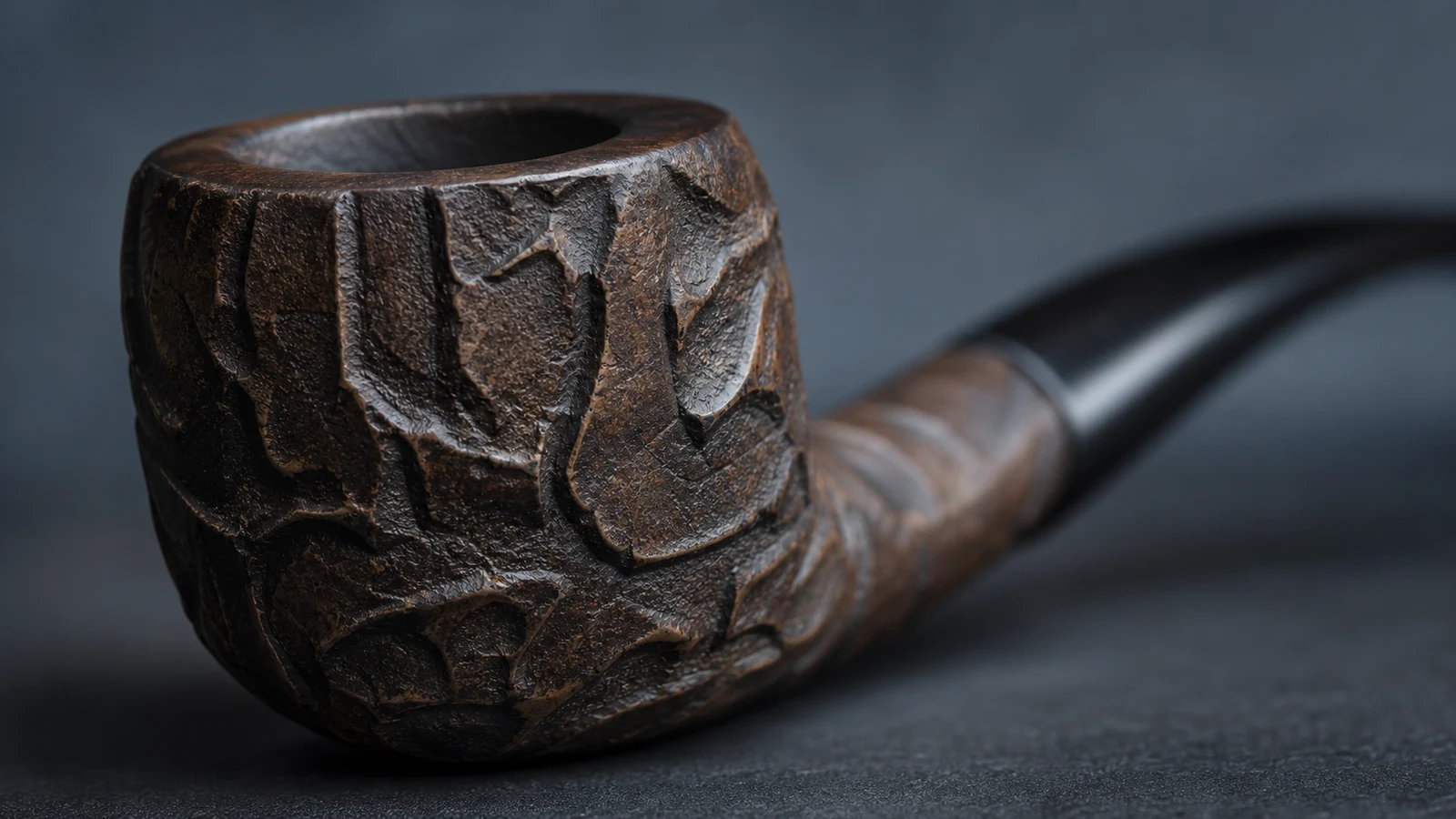
A carved briar tobacco pipe should be evaluated as a three-dimensional object, not as a promise hidden inside the word “carved.” Photographs can show visible relief, repeated cuts, sculptural transitions, and how the surface changes from one angle to another. A listing can state that an item is carved. Neither source alone proves who performed the work, how it was produced, what lies beneath the finish, or whether the carving delivers a performance benefit.
The practical rule is simple: record what the seller calls the pipe, describe only what the supplied images actually show, and mark maker, process, material, dimensions, condition, and performance as unconfirmed unless the exact product record supports them. The site's product guide uses the same separation between visible evidence, source labels, and unknown specifications.
What “carved” can mean in a listing
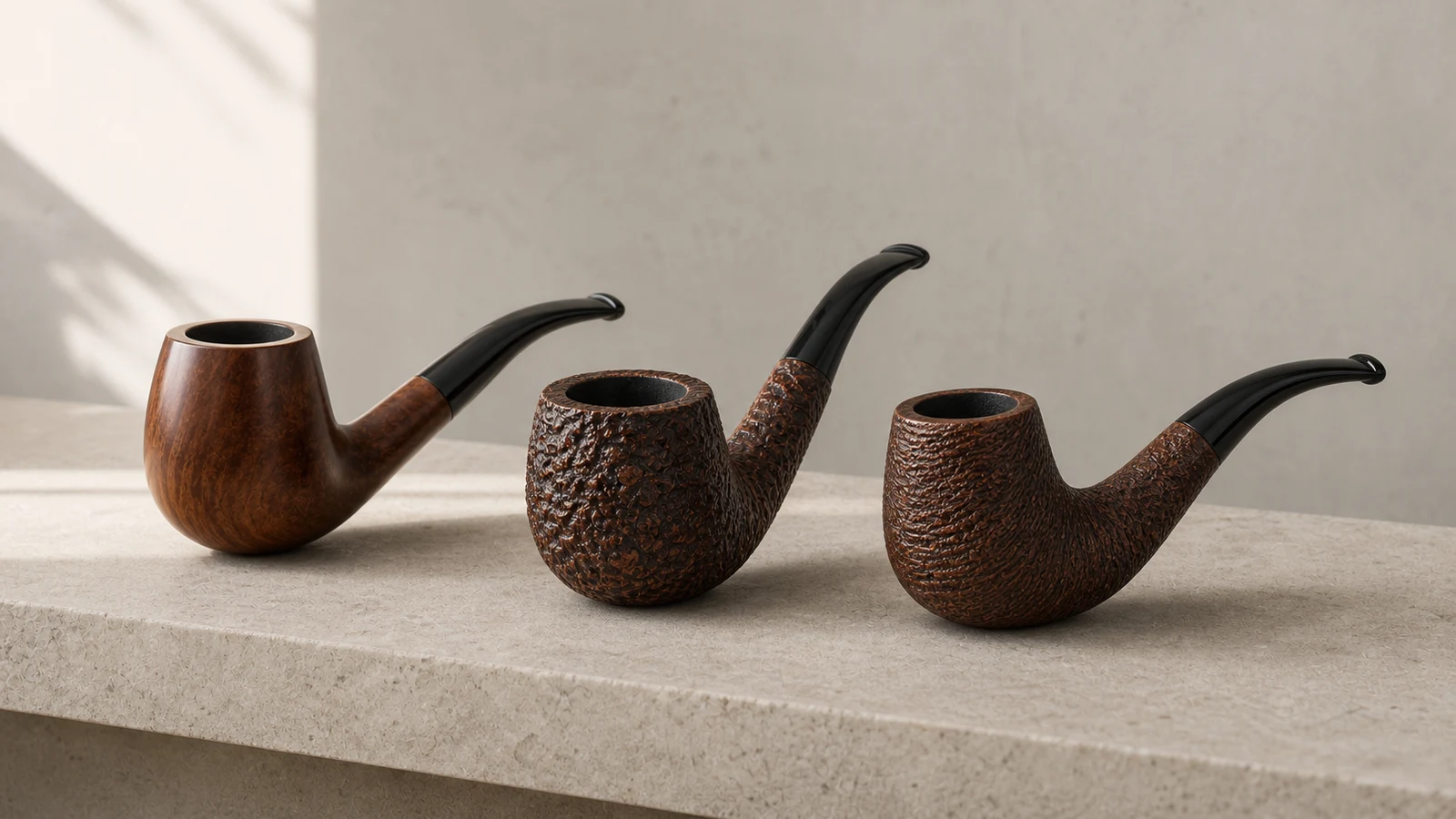
“Carved” is a broad surface or design label. It may describe shallow repeated marks, deep relief, a figurative motif, a textured panel, an organic rim, or a body shaped into a sculptural form. Sellers may also place carved, rusticated, freehand, artisan-style, and grain terms close together even though they do not answer the same question.
A cautious comparison keeps those fields separate:
| Evidence field | What it may support | What it does not establish |
|---|---|---|
| Listing says “carved” | The seller applies that label to the item | Tool, method, labor time, or named carver |
| Side photographs show relief | Visible depth, direction, and placement on that side | Complete coverage or hidden-side condition |
| Top view shows an irregular rim | The photographed rim has visible variation | Natural origin, chamber geometry, or wall thickness |
| Close-up shows color changes | Surface appearance under that lighting | Exact color, stain formula, or wood identity |
| Category groups carved examples | A useful discovery path | Shared dimensions, quality, process, or performance |
The table is not an authenticity test. It is a way to stop a visible detail from quietly becoming a manufacturing or performance claim.
Read the carved surface in zones
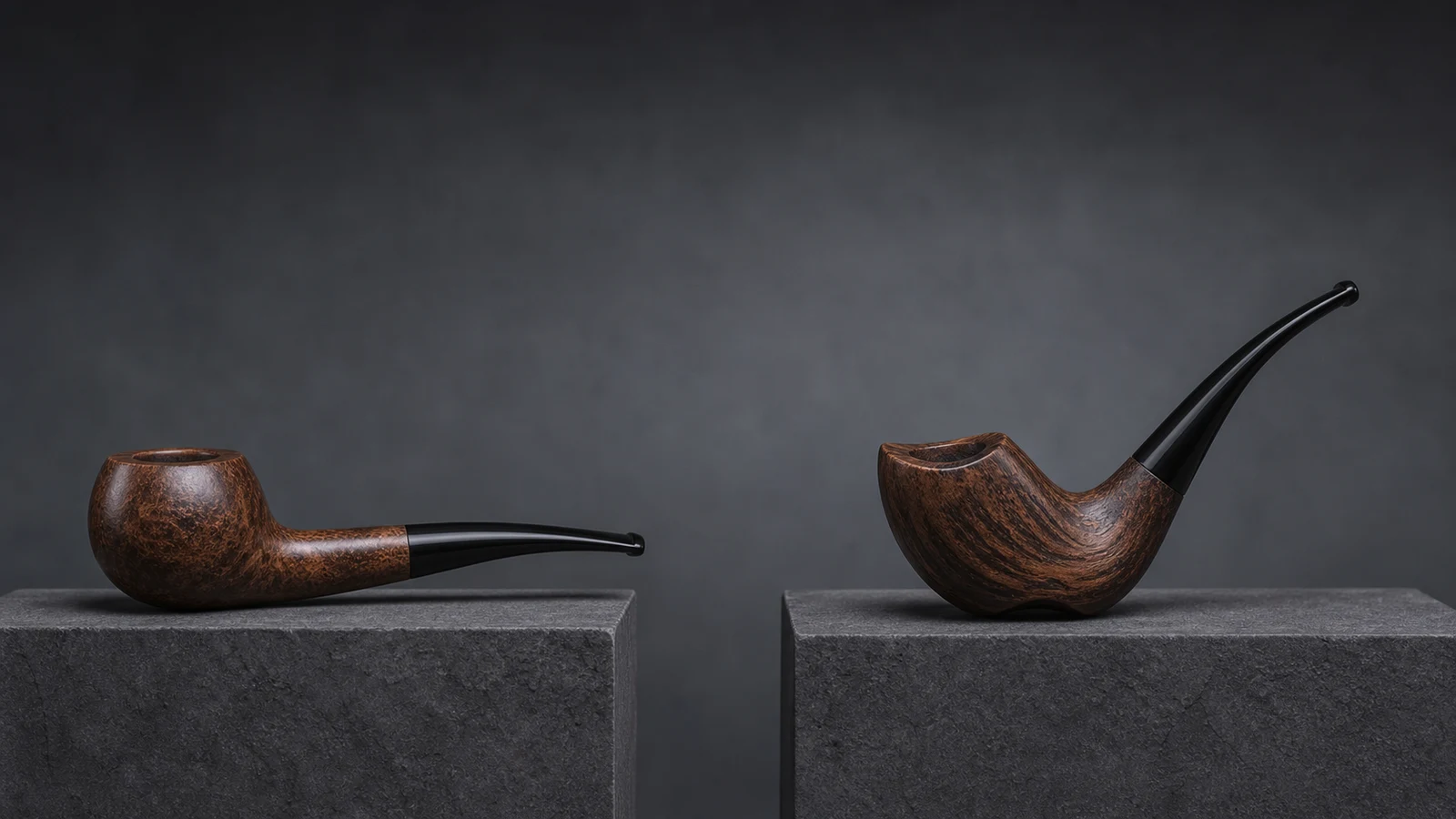
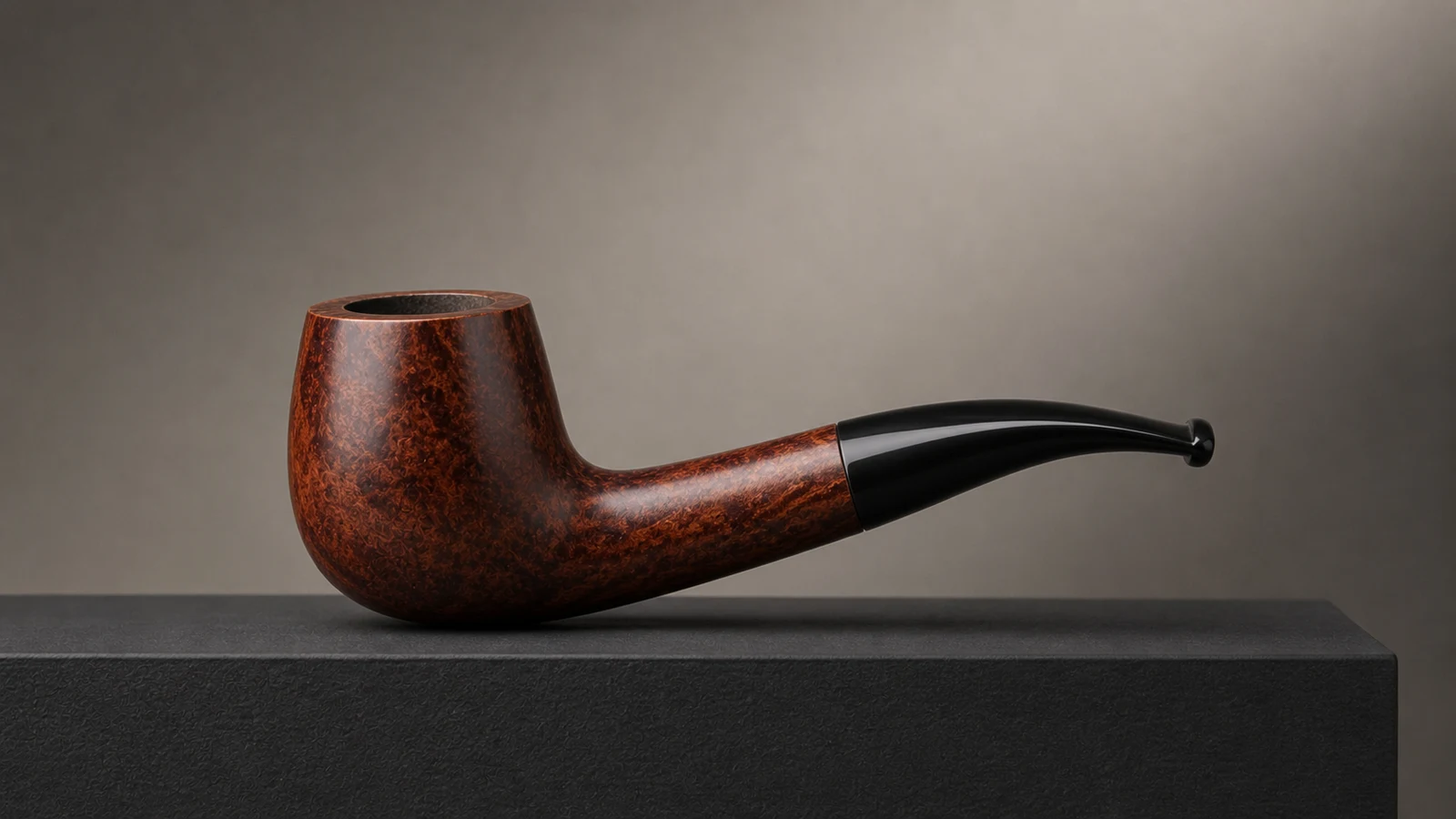
Start with the complete silhouette. Identify the bowl, rim, shank, and stem, then note where the carved treatment begins and ends. A close crop can make a small panel look like full coverage, while a dramatic side view can hide a smooth reverse side. If the listing provides several images, compare the same transition across them.
Useful visible observations include:
- whether the marks are shallow or strongly raised in the supplied views;
- whether the pattern repeats or changes around the bowl;
- whether smooth panels interrupt the texture;
- how the carving meets the rim, base, and shank;
- whether edges appear crisp, rounded, irregular, or obscured by lighting;
- whether the stem is carved, smooth, or simply outside the photographed area.
These are descriptions, not grades. Deep-looking relief is not automatically better, more durable, handmade, or more comfortable. A shallow pattern is not automatically mass-produced. The images alone do not establish either story.
Why photo angles matter more for carved detail
Relief depends heavily on light direction. Side lighting can create strong shadows that emphasize depth; flat front lighting can suppress the same detail. A wide-angle image can exaggerate the nearest edge, while a top-down view may compress the bowl and shank. Color can also shift with exposure, background, and display settings.
For a useful visual record, look for a complete side view, the opposite side, front and rear transitions, a top view of the rim, and a close-up that retains enough context to locate the detail. If one side is missing, treat its carving and condition as unknown. If every image uses the same dramatic light, ask for a neutral view rather than estimating depth from shadow.
The shop can provide current source-labeled examples for practicing this comparison. Its photographs support observations about the particular views supplied; they do not authorize assumptions about unseen surfaces or facts absent from the individual listing.
Keep carving, material, and finish separate
The phrase “carved briar tobacco pipe” combines at least two claims: a carved surface and briar material. Verify each one independently. Texture does not prove the wood beneath it, and a material label does not prove how the surface was produced. Likewise, visible gloss, color, or contrast does not identify a specific stain, coating, wax, or treatment.
If the exact listing identifies briar, you may record that as a source claim. If the gallery shows textured relief, you may describe that visible feature. Do not use grain appearance, color, or carving style to invent origin, curing history, age, or material grade. Those details require their own documentation.
It also helps to distinguish carving from finish categories. Smooth describes a comparatively even visible surface. Rusticated and sandblasted are commonly used as finish or texture terms. Carved may be used more broadly for deliberate relief or sculptural detail. A seller can combine terms, but readers should not merge them unless the item record does.
The finish-label comparison owns that process question. This page owns only the visible relief and the evidence required before attributing it.
Maker and process claims need direct evidence
A distinctive pattern may look personal, but appearance cannot name the maker or reconstruct the workshop process. “Handmade,” “hand carved,” “artisan,” and “one of a kind” are separate claims. Each should appear in a reliable source connected to the exact item before it enters a factual comparison.
BriarWorks' first-party company account describes its own team and production, while its pipe-design discussion explains why visual classifications are useful but incomplete. These sources can support statements about BriarWorks; they cannot attribute an unrelated carved pipe. Use the handmade versus Freehand evidence guide before repeating a process claim.
A second complication is later surface work. Briarville lists rustication and sandblasting as optional restoration operations. That does not prove any specific pipe was altered, but it shows why a present texture cannot by itself establish when or by whom the surface was made.
When maker history matters, ask for:
- the maker or workshop name as stated for this item;
- any stamp, signature, or identifying mark shown clearly;
- the seller's exact production-method wording;
- whether the photographs show the exact item or a representative example;
- whether uniqueness applies to the carving, the whole pipe, or neither.
Even a visible stamp requires context. A photograph can show marks, but the seller should explain the attribution and whether the mark belongs to the item being offered. Avoid turning an unreadable mark into a confident maker name.
Carving is not a performance guarantee
Surface relief may change visible texture and external geometry, but a catalog photo cannot establish an operating outcome. Do not claim that a carved surface necessarily changes cooling, heat management, weight, grip, durability, or any other performance characteristic. Those outcomes depend on details that the label and exterior images do not prove.
The same boundary applies to internal construction. Exterior carving does not reveal chamber dimensions, airway alignment, wall thickness, filter system, or repair history. If one of those facts controls the decision, look for an exact specification or request confirmation before ordering.
A carved-pipe photo and listing checklist
- The complete silhouette is visible, not only a detail crop.
- Both sides and the major bowl-to-shank transitions are shown.
- The written listing uses the carving term being compared.
- Material wording is recorded separately from surface wording.
- Maker and production claims have item-specific support.
- Condition is stated rather than inferred from texture or shadows.
- Dimensions, filter status, and included items are confirmed separately.
- The exact-item or representative-image status is clear.
- Current price, stock, shipping, and returns are rechecked.
- No visual feature is being used as a performance promise.
This checklist deliberately leaves unknowns visible. An unanswered question is more useful than a polished but unsupported description.
Frequently Asked Questions
What should I verify when researching a carved briar tobacco pipe?
Verify the seller's exact carving and material labels, the relationship between the photographs and the item offered, visible coverage from multiple angles, condition, dimensions, maker attribution, production claims, filter status, package contents, and current order terms. Treat any missing field as unknown.
Which carved details can product photos confirm?
Photos can support observations about visible relief, pattern placement, smooth panels, rim treatment, external transitions, and surface appearance under the shown lighting. They cannot reliably confirm hidden-side detail, material, maker, process, dimensions, internal construction, or performance.
Does visible carving prove that a pipe is handmade?
No. Handmade and hand-carved are production claims, while carved can function as a visual or seller-supplied design label. Require explicit, item-specific evidence before describing how the pipe was made.
Where can I compare current carved catalog examples?
Browse the current pipe catalog and open each product record rather than comparing thumbnails alone. Use the product guide to organize visible facts and unresolved questions, then confirm important details on the exact listing before making a decision.
Carved detail is most useful when it remains an observable feature instead of a shortcut to a larger story. Compare the complete image set, preserve the seller's wording, and let direct evidence—not texture, shadow, or category positioning—control every material, maker, condition, and performance claim.
Related posts
Product notes, store updates, and purchase guidance for the storefront.