Bulldog vs Rhodesian Pipes: Reading the Shape Labels
Compare Bulldog and Rhodesian pipe labels through bowl profile, bead lines, and shank shape without treating catalog names as universal rules.
Written by
The Tobacco Pipe Editorial Team
The store editorial team reviews product facts, care boundaries, and buying guidance against the current catalog and source evidence.
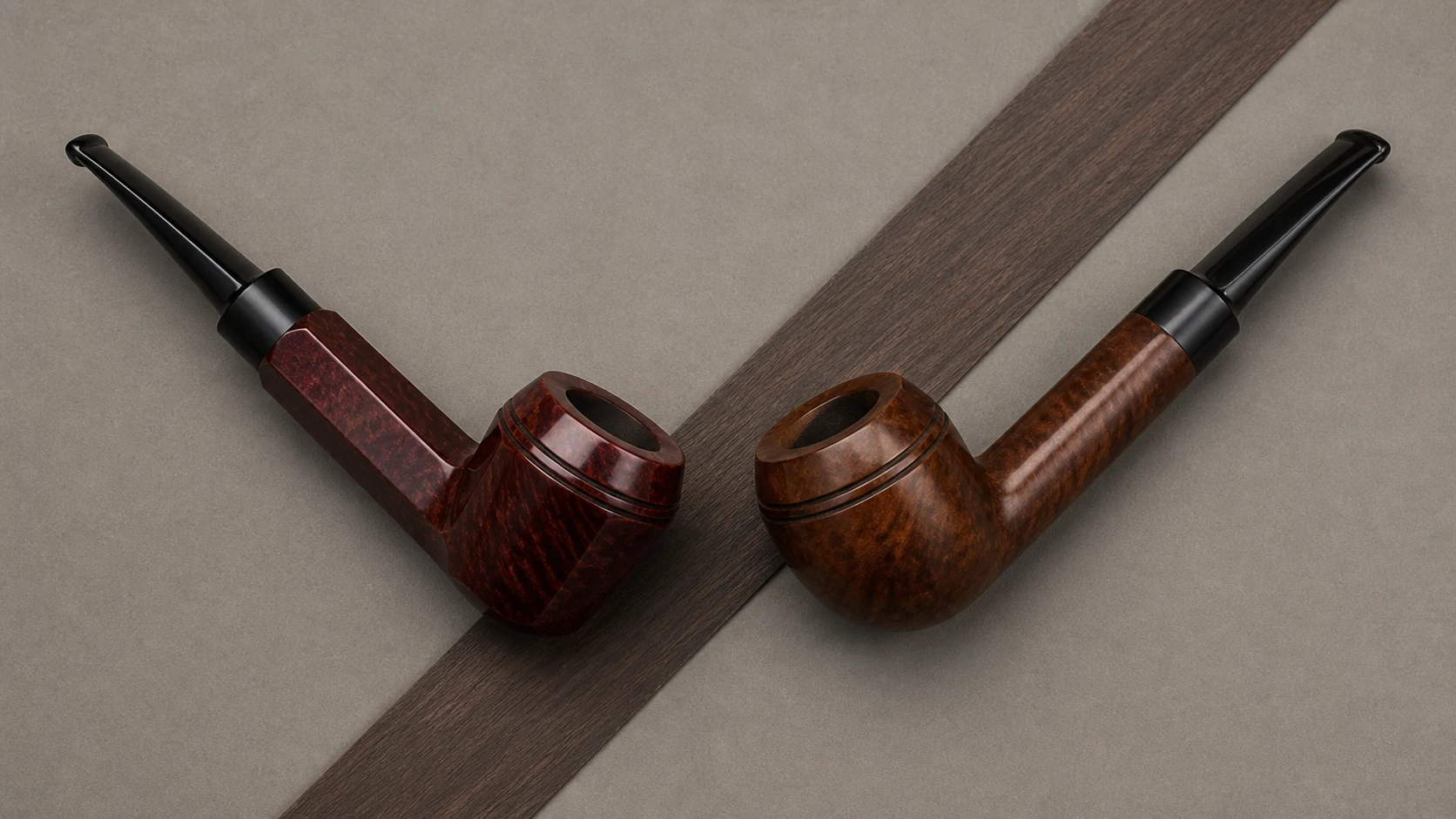
Bulldog and Rhodesian pipes commonly share a broad, often squat bowl with one or more circumferential lines near the upper bowl. The usual catalog distinction is the shank: a Bulldog often carries an angular or diamond-section shank, while a Rhodesian more often carries a round or oval shank. This is a useful visual convention, not a universal industry rule.
Read the complete bowl-and-shank profile and record the seller's label. Some catalog titles combine “Rhodesian” and “Bulldog,” demonstrating that real listing language can overlap. Do not overwrite that wording merely because a single feature appears to favor one textbook description.
The visual shape index provides the wider family map, and the pipe types guide keeps bend separate from bowl and shank. This comparison owns only the Bulldog-versus-Rhodesian convention and its naming ambiguity.
Bulldog and Rhodesian at a glance
| Feature | Common Bulldog cue | Common Rhodesian cue | Evidence limit |
|---|---|---|---|
| Bowl profile | Broad and often squat | Broad and often squat | Bowl forms overlap substantially |
| Upper-bowl lines | One or more visible rings may appear | One or more visible rings may appear | Number and treatment vary |
| Shank cross-section | Often angular or diamond-like | Often round or oval | Photos may hide the cross-section |
| Shank-to-stem line | Can look more faceted | Can look smoother or more rounded | Exact transition varies |
| Bend | Straight and bent versions may appear | Straight and bent versions may appear | Bend is not the primary distinction |
| Catalog label | Bulldog | Rhodesian, or sometimes a combined label | Seller terminology is not standardized |
The shank convention is usually more useful than trying to decide from the bowl alone.
Why the bowls are easy to confuse
Both labels are commonly associated with a bowl that carries visual width around its upper or middle body, then angles or curves toward the heel. One or more incised or raised-looking rings may circle the upper bowl. Depending on the camera and finish, these lines can appear sharp, soft, doubled, or partly hidden.
The rim itself is not always the decisive area. When a listing brief refers to “rim lines,” inspect whether the visible rings sit below the actual chamber rim and travel around the bowl. Do not assume a precise number, spacing, or cutting method. Photographs can show that lines are present; they cannot always reveal how they were made.
Because the bowl families overlap so strongly, a cropped photograph that omits the shank may not support a confident Bulldog-versus-Rhodesian distinction. Keep the classification provisional until the full profile and catalog title are visible.
The shank is the practical comparison point
The external Smokingpipes glossary describes the classic Bulldog with a beveled and tapered bowl, bead lines, and a diamond shank. A BriarWorks comparison documents the popular convention of a round-shank Rhodesian versus a diamond-shank Bulldog, while explicitly acknowledging the long-running naming dispute. It is a useful convention, not a universal law.
Side views alone can be misleading. A diamond shank may show only one flat face, and a round shank can look flat where light falls evenly. Look for an overhead, underside, or three-quarter photograph that reveals edges and curvature. The junction between shank and stem can provide another clue, but it is not a substitute for a clear cross-section.
If the listing title says Rhodesian while the shank looks angular, preserve both facts: “seller-labeled Rhodesian; photographed shank appears angular.” That is more accurate than declaring the product mislabeled from incomplete images.
Bend is a separate attribute
Neither Bulldog nor Rhodesian is automatically straight or bent. A curved shank-and-stem line changes the full silhouette, while the bowl and shank conventions remain the main shape evidence. Record the exact bend attribute when the listing supplies one.
This separation prevents a common mistake: identifying every bent example as Rhodesian or every straight example as Bulldog. Bend alone does not resolve the label. The product guide provides the same multi-field method for other pipe families and listing details.
A photo-based comparison checklist
Use these steps for each listing:
- Find one clear image containing the entire bowl, shank, and stem.
- Note the broad bowl profile without assigning the final label yet.
- Inspect the upper-bowl lines and distinguish them from the rim edge.
- Find an angle that reveals whether the shank is angular, round, or oval.
- Check how the shank transitions into the stem.
- Record straight or bent profile separately.
- Record the title and structured shape attribute.
- Preserve a combined or ambiguous catalog label rather than forcing a rule.
Surface texture can obscure edges, while strong highlights can create false ones. Compare at least two angles before describing the shank cross-section.
What combined catalog wording means
The 2026-07-16 intake contains two Bulldog titles and two combined Rhodesian Bulldog titles, but no Rhodesian-only title. The live
Bulldog Straight and
Rhodesian Bulldog Bent
pages show both patterns. That evidence does not support claiming a broad local
Rhodesian range.
A combined label can indicate that the seller sees the product as sitting between familiar conventions or wants the listing discoverable under both terms. It does not prove that every seller uses the words in the same way. Use the exact product title, photos, and attributes instead of normalizing the name to fit an external chart.
Catalog presence is not current-stock proof. The live shop should be checked for present availability, pricing, and item-level details.
What the visible lines do and do not establish
Circumferential bowl lines are useful identification cues, but they do not prove material, construction quality, wall thickness, or finish process. A line may be carved, shaped, stained, or emphasized by lighting; use the seller's wording when the manufacturing detail matters.
The same applies to the angular or rounded shank. Its visible cross-section does not determine airway geometry, filter compatibility, durability, balance, comfort, airflow, heat behavior, or health outcomes. Those claims cannot be derived from a shape family.
Compare exact listings, not generic labels
Once the visual preference is clear, make a product-level comparison. Record the seller's shape name, bowl profile, upper-bowl lines, shank cross-section, bend, supplied dimensions, named material and finish, condition, filter information, photographs, price, availability, and package contents.
Use stated numbers with units. Do not estimate dimensions from differently cropped images or transfer specifications from another Bulldog or Rhodesian. If a field is absent, leave it unresolved and ask the seller when it affects the decision.
The objective is not to prove that one family is better. It is to match a visible bowl-and-shank preference with an exact listing whose important facts are clear.
If a strong curve dominates the photograph, use the bent versus straight guide to record that modifier without letting it decide Bulldog versus Rhodesian.
Frequently asked questions
What should I check when comparing Bulldog and Rhodesian pipes?
Check the full bowl profile, the location of upper-bowl lines, and especially the shank cross-section. Then record the seller's label, bend, dimensions, material claims, finish, condition, filter details, package contents, and availability separately.
Which visible features help distinguish Bulldog and Rhodesian listings?
Clear photos can support observations about bowl outline, visible rings, shank edges or curvature, stem line, color, and texture. They cannot reliably confirm exact dimensions, hidden construction, filter compatibility, finish process, or performance.
What listing facts remain unverified after comparing the photos?
Ask for missing measurements, named material and finish, condition, filter information, package contents, and evidence that the images show the exact item. If the title combines the names or conflicts with the photos, ask how the seller applies the label.
How should I handle Bulldog/Rhodesian wording in the current shop?
Browse the shop for Bulldog, Rhodesian, and combined catalog wording. Open each exact listing and compare its own title, photographs, and attributes rather than assuming one shape guide controls every seller's terminology.
Related posts
Product notes, store updates, and purchase guidance for the storefront.