Tobacco Pipe Tools: What Each Tool Is For
Understand what tampers, reamers, picks, cleaners, and combination tools are for, including fit limits and conditions for stopping.
Written by
The Tobacco Pipe Editorial Team
The store editorial team reviews product facts, care boundaries, and buying guidance against the current catalog and source evidence.
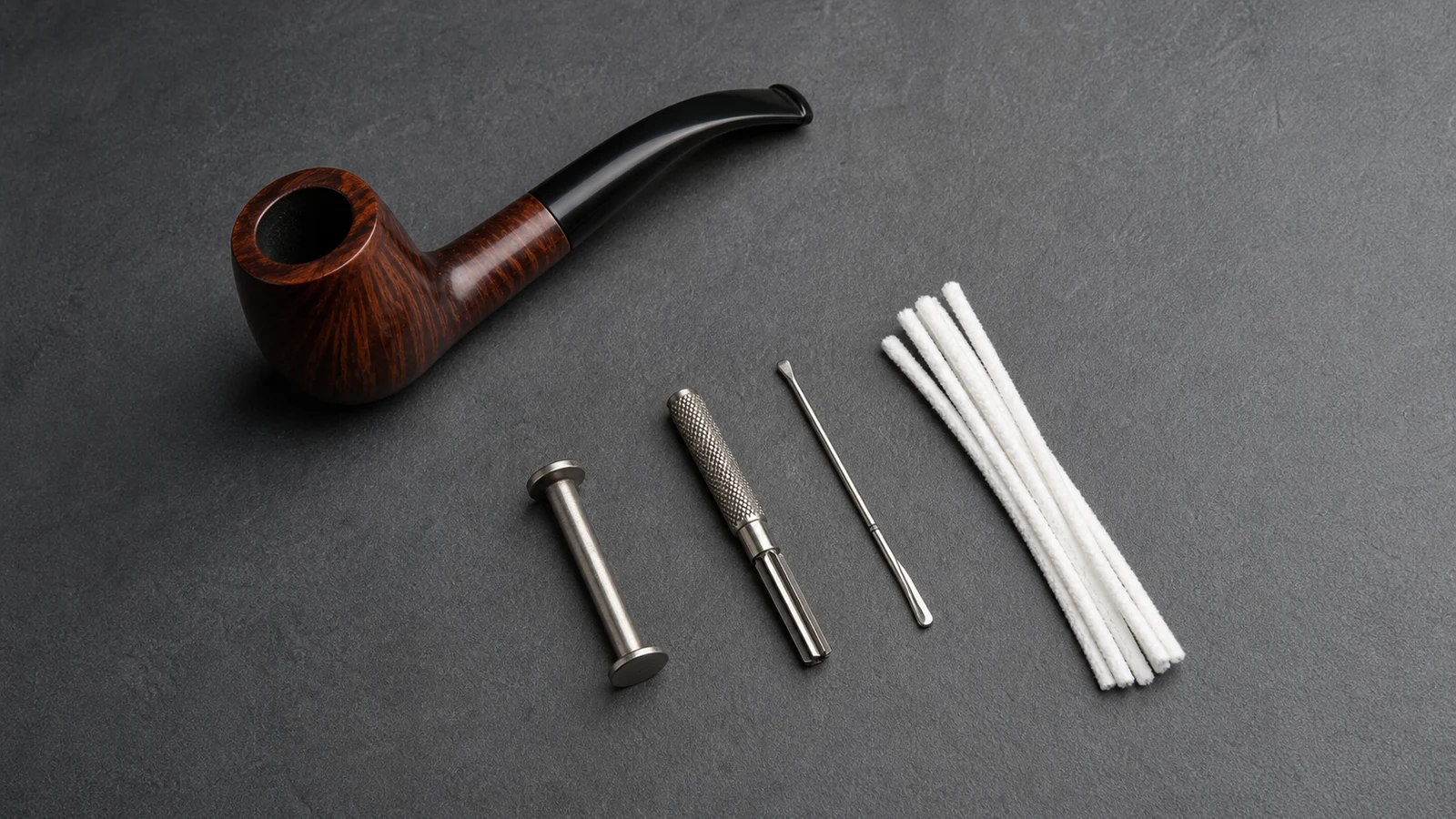
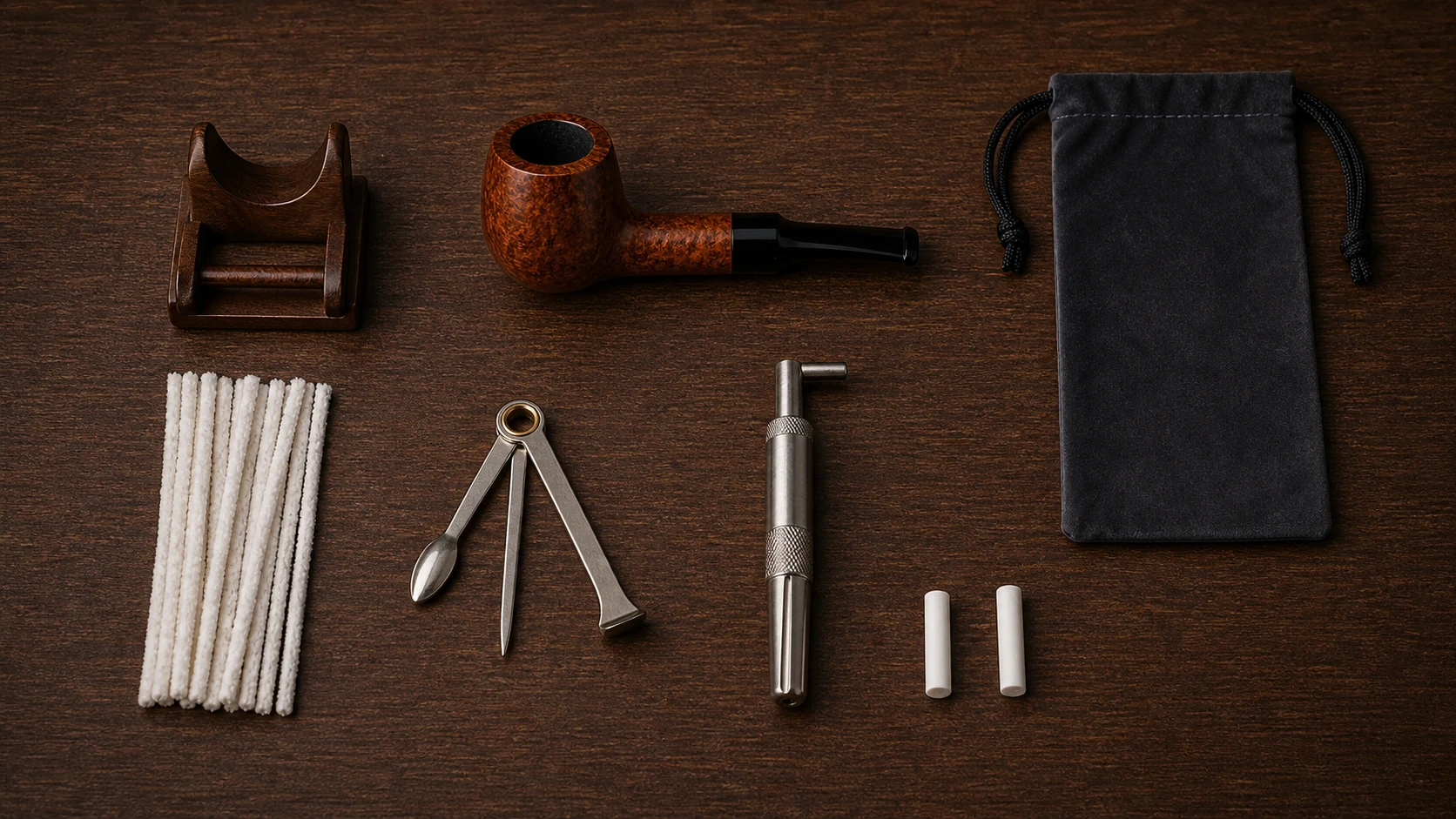
The main tobacco pipe tools have different jobs: a tamper presses loose material in the bowl, a reamer removes part of an established interior deposit, a pick reaches small or obstructed areas, and a pipe cleaner passes through an airway when its size and flexibility are suitable. Those labels describe purposes, not automatic compatibility. Verify the tool's working dimensions, shape, edges, instructions, and package contents against the exact pipe and task before ordering or using it.
This guide explains tool categories without recommending an accessory for a current catalog pipe. The site is focused on pipes and does not imply that tampers, reamers, picks, cleaners, or tool sets are sold here. A visible bowl or stem profile can help you frame questions, but it cannot confirm the hidden measurements a fit-dependent tool may require.
The four tool categories at a glance
| Tool | Intended job | Facts to verify | Important limit |
|---|---|---|---|
| Tamper | Press material already in the bowl | Face size, face shape, edge profile, handle, instructions | A broad or sharp-edged face may not suit every chamber |
| Reamer | Reduce an established interior deposit | Tool type, working range, chamber geometry, adjustment method | Exterior bowl shape does not establish chamber fit |
| Pick | Reach or gently dislodge material in a small area | Tip shape, length, rigidity, edges, stated purpose | A pointed tip can contact an unseen surface |
| Pipe cleaner | Pass through a compatible airway or accessible passage | Length, thickness, flexibility, texture, material description | “Standard” does not mean it will pass through every airway |
| Multi-tool | Combine two or more functions | Every component, dimensions, hinge control, included pieces | A compact set is not necessarily complete or universally sized |
Start with the task rather than the accessory name. “I need a pipe tool” is too broad to evaluate. “I need to compare the stated face diameter of two tampers” or “I need the manufacturer's working range for this reamer” produces a fact that can be checked.
Current maker listings illustrate why the name alone is incomplete. Missouri Meerschaum describes its Czech Pipe Tool as a folding set with a flat tamper, a straight pick, and a scoop, while its simpler Pipe Nail has a flat tamper end and a wedge-shaped scoop. These are attributed examples of component lists, not a standard that every “pipe tool” follows.
What a tamper is for
A tamper is generally the broad-ended component in a pipe tool. Its purpose is pressing rather than cutting or scraping. Product pages may show flat, rounded, narrow, or decorative faces, but a photograph without scale cannot establish whether that face is appropriate for a particular chamber.
When comparing tampers, look for:
- the stated diameter or width of the working face;
- whether the face is flat, convex, concave, or otherwise shaped;
- whether its perimeter appears smooth or sharply defined;
- the handle length and grip described by the seller;
- the tool material and finish as explicitly stated;
- care instructions and any limits supplied by the maker.
Do not choose a tamper from the exterior size of a bowl alone. A large-looking bowl can have a narrower chamber, and perspective can make either dimension look different. If the working face might bind against the chamber wall or if its edge is difficult to assess, ask the accessory seller for measurements.
What a reamer is for
A reamer is a material-removal tool intended to reduce an established deposit inside a bowl. It is not interchangeable with a tamper, and its fit depends on the actual chamber rather than the pipe's silhouette. Adjustable-blade, fixed-size, tapered, and scraper-like designs can make contact in different ways.
The minimum useful evidence includes the reamer type, smallest and largest working size, adjustment method, instructions, and included heads or components. On the pipe side, chamber diameter, taper, depth, condition, and prior work may all matter. If those facts are missing, compatibility remains unknown.
Gentle use begins with restraint: a reamer should not be forced, rocked to compensate for poor fit, or treated as a way to discover the chamber's dimensions. Stop if it cannot sit squarely, catches, needs pressure, or leaves you unsure which surface it is contacting. An uncertain or valuable pipe is better assessed by an experienced repair professional than used as a fit test.
What a pick is for
A pick is the narrow, pointed or probe-like part of some pipe tools. Sellers may describe it for clearing a localized obstruction, loosening residue, or reaching a confined area. That narrow profile can be useful, but it also concentrates contact in a small spot.
Verify the tip shape, rigidity, length, edge finish, and stated purpose. A photo may show whether a tip looks straight or curved, but it cannot reliably reveal its exact thickness, surface finish, or how it will meet a hidden passage. Do not infer that a pick belongs in every opening that it can physically enter.
Use the least force possible and stop when visibility or control ends. A pick is not a substitute for knowing the route, material, or condition of the surface ahead of it. If a blockage persists, repeated probing can add uncertainty rather than solve it.
What pipe cleaners are for
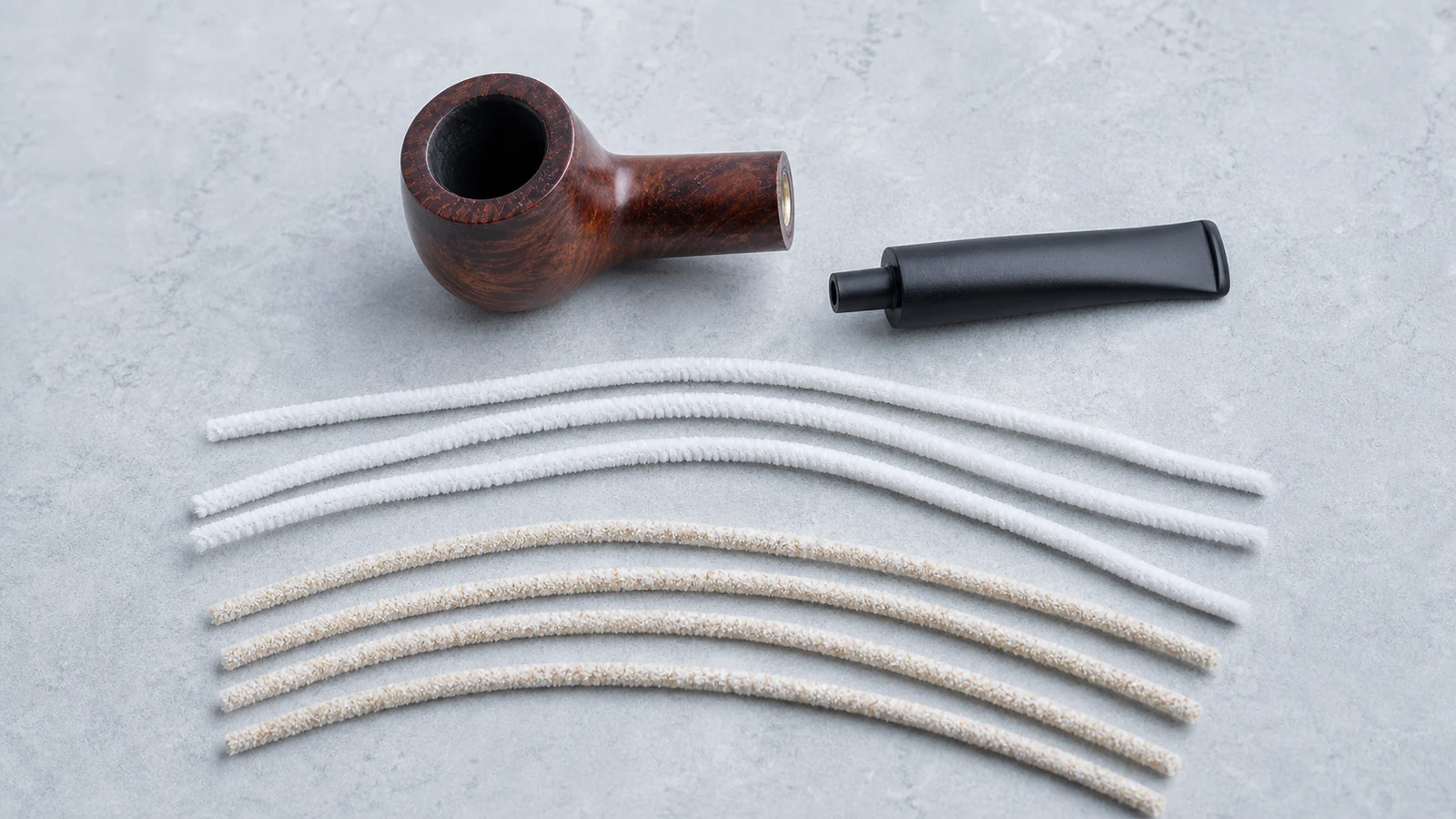
Pipe cleaners are flexible consumable tools sold in several constructions. Listings may distinguish regular, tapered, bristled, soft, extra-absorbent, or other versions. Those names are useful only when the listing also explains the relevant dimensions and construction.
Before ordering, compare stated length, thickness, flexibility, texture, material description, and quantity. Confirm whether the count means individual cleaners, bundles, mixed styles, or packs. If the pipe's airway specification is not stated, a product image cannot establish fit. The apparent opening, stem shape, or a familiar model label is not enough.
Material and intended size can vary by listing. For example, Missouri Meerschaum's BJ Long Regular Pipe Cleaners page states 100% cotton and describes that specific product for medium and small pipes. Treat those as seller facts for that cleaner, not as specifications for every regular cleaner. The cleaner-types guide separates soft, bristled, tapered, and thin designs in more detail.
A cleaner should not be forced through resistance. Some pipe designs or conditions may prevent a cleaner from following the complete route while assembled. Follow product-specific care information rather than assuming that a technique demonstrated on another pipe transfers to yours.
Multi-tools still need component-by-component review
A compact three-part tool often combines a tamper, pick, and spoon-like or scraper-like component. Other sets pair a tamper with a reamer or include several interchangeable heads. “Three-in-one” tells you the count of advertised functions, not their size, geometry, or suitability.
Audit a set in five steps:
- Write down every component named in the description.
- Match each pictured piece to a named function.
- Record the working dimensions or range for every fit-dependent part.
- Check how folding parts lock, move, or remain controlled.
- Treat any pictured but unnamed item as unconfirmed package content.
Decorative presentation, metal color, or a vintage-style finish does not prove material, durability, or precise manufacture. Use the seller's written specifications and instructions for those claims.
What product photos can and cannot confirm
Accessory photos can support visible observations about the number of displayed components, broad face shape, relative proportions, folding layout, and exterior finish. Multiple angles may also reveal whether an edge looks rounded or whether a joint appears aligned.
Photos usually cannot confirm exact dimensions, working range, alloy, rigidity, package quantity, edge smoothness, or compatibility. Scale markers help only when the measurement method is clear. A staged image of a tool beside a pipe shows that combination in one photograph; it does not prove fit with the pictured pipe or any other pipe.
The same evidence boundary applies when looking at this site's current pipe information. The briar pipe product guide explains how shape labels and photos help organize a comparison while hidden specifications remain unknown until the individual listing confirms them.
If the task is assembling a limited maintenance set rather than learning what each component does, continue with the tobacco pipe cleaning-kit checklist. That page keeps optional tools separate from the low-intervention core.
For a wider purchase review that also covers fit-dependent consumables, storage, stands, and listed package contents, use the tobacco pipe accessories checklist. It treats each accessory category as a separate verification task rather than assuming one bundle is complete.
A gentle-use and buying checklist
- Define the exact task before choosing a tool category.
- Read the complete accessory listing, not just the search result title.
- Verify working dimensions, range, shape, edge profile, and instructions.
- Confirm the exact package contents and quantity.
- Compare fit-dependent measurements with the exact pipe, not a similar shape.
- Keep unknown chamber, airway, material, and condition facts marked unknown.
- Do not force a tool or use resistance as a measuring method.
- Stop when the tool cannot remain controlled or the contacted surface is unclear.
- Ask the accessory seller for missing specifications before ordering.
- Seek experienced repair help when the pipe's condition or required work is uncertain.
Frequently asked questions
What should I verify when researching tobacco pipe tools?
Verify the tool's stated purpose, working size or range, shape, edges, material description, instructions, and exact package contents. For fit-dependent tools, separately confirm the relevant chamber or airway facts for the exact pipe.
What can a product photo show about a multi-tool's components?
Photos can support observations about visible component count, broad geometry, folding layout, and exterior finish. They do not reliably confirm dimensions, material, package quantity, hidden condition, or compatibility without corresponding listing text.
Is a three-in-one pipe tool all a beginner needs?
Not necessarily. It may combine common functions, but completeness depends on the pipe and the actual care task. Review every component and its dimensions rather than assuming that the bundle name guarantees fit or coverage.
Can the pipe product guide confirm that tools are available or compatible?
Use the product guide to compare visible pipe shapes and identify which hidden facts still need confirmation. It provides selection and care context, but it is not a tools catalog and does not establish accessory availability or tool compatibility.
The useful tool is the one matched to a defined task with documented fit. Treat “universal,” “standard,” and “complete” as claims to verify, keep gentle use and clear stop conditions ahead of convenience, and leave any missing dimension or compatibility fact unresolved until the appropriate seller confirms it.
Related posts
Product notes, store updates, and purchase guidance for the storefront.